Museo Reina Sofía — Guernica & What Else to See
Everyone comes for Guernica. The painting delivers. But Floor 2 has an entire history of 20th-century Spanish art that most visitors walk past on their way out.
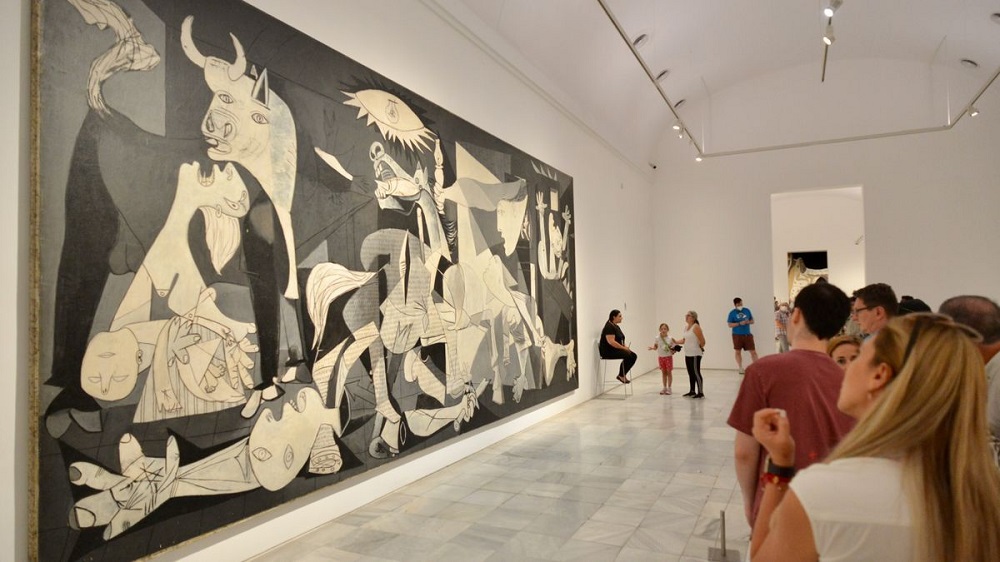
Guernica is in Room 205.10, Floor 2, Sabatini building. You'll see it within 10 minutes of walking in. It's 3.5 metres tall and 7.8 metres wide, painted in black, white, and grey. Picasso finished it in five weeks for the 1937 Paris World's Fair, months after German and Italian bombers destroyed the Basque town. The painting is as large and as blunt as the event it records.
In 3 minutes, you'll know:
- Why Floor 2 is the only floor most visitors need
- The works beyond Guernica that make this museum worth the visit
- When to go, how to skip the crowds, and what's changed since 2023
What makes the Reina Sofía different
The Reina Sofía does one thing the Prado and Thyssen don't: it puts Spanish art in political context. Floor 2 walks you through the first half of the 20th century, from Cubism to the Spanish Civil War to Surrealism. The art isn't arranged by style alone. It's arranged by what was happening in Spain.
That's what makes Guernica land so hard. You don't see it in isolation. You walk through rooms of Cubist experimentation (Juan Gris, early Picasso), then the Spanish Republic, then war. By the time you reach Room 205.10, you understand what Picasso was responding to.
The building itself is a converted 18th-century hospital (Sabatini wing) connected to a glass-and-steel extension by Jean Nouvel. The collection lives in the old building. The Nouvel wing has temporary exhibitions, the bookshop, and a good café with a covered courtyard.
Most visitors spend 60 to 90 minutes on Floor 2 and leave. That's a reasonable visit. If you add Floor 4 (post-war Spanish art: Tàpies, Saura, Chillida, Bacon), plan for 2 hours total.
The Reina Sofía guide — Floor 2 decoded
- Room-by-room route through Floor 2 with timing
- Where to stand in front of Guernica (and what to notice on the right side)
- The Dalí, Miró, and Cubism rooms most people rush past
- Designed for your phone — open it inside the museum
What are the best works to see at the Reina Sofía?
Stand in front of Guernica and look at the right side of the canvas. Most visitors focus on the screaming horse and the bull on the left. The woman on the far right, falling through a burning building with arms raised, is where the painting reaches its peak of panic. Give it five minutes. The scale only registers with time.
Find Dalí's The Great Masturbator (Room 205.13). Painted in 1929, the year Dalí met Gala. The soft, melting profile is a self-portrait. It's one of Dalí's most personal works, painted before he became a brand.
Look for Ángeles Santos's A World (Un Mundo) on Floor 2. Santos painted this at 17. A surreal, cosmic landscape made years before the movement had a name in Spain. The museum has given her more space in recent reinstallations, and it's deserved.
Notice how Juan Gris's Cubist works (Rooms 204.01-02) differ from Picasso's. Gris builds from colour, Picasso from form. Standing in these rooms, the difference is immediate. Gris is warmer, more structured, easier to read.
Compare Miró's Man with a Pipe (Room 206.02) with his later work at Fundació Miró in Barcelona. This is Miró before the playful symbols. The shapes are already there, but the palette is darker, the mood heavier. The evolution is dramatic across the 400km between cities.
What do most visitors wish they knew about the Reina Sofía?
The museum is closed every Tuesday. This catches people off guard, especially those planning a Prado-Reina Sofía-Thyssen route across two days.
Photography is allowed everywhere in the collection, including Guernica. The ban was lifted in September 2023. No flash or tripods, but your phone is fine.
Bring a jacket. Multiple visitors mention aggressive air conditioning year-round, especially on Floor 2. The temperature is kept low to preserve the paintings. Choosing between the Prado and Reina Sofía? Our Prado vs Reina Sofía guide breaks it down. For modern and contemporary art elsewhere, MACBA in Barcelona offers a different curatorial approach to 20th-century work.
The free evening slot (19:00-21:00, Monday and Wednesday-Saturday) draws crowds. If you go during free hours, walk past Guernica first and circle back at the end. Most free-entry visitors cluster around it and leave. For timing and comparison with other Madrid museums offering free entry, see our complete guide to free museums in Madrid 2026.
Where to book
Our take: Reina Sofía rarely sells out — the official €12 is the default. Most visitors do Guernica and walk out 45 minutes later. Don't. Floor 2 has Dalí, Miró, and the rest of 20th-century Spanish art, and it's quieter than the Guernica hall by 11 AM. Enter through the Nouvel building if you've booked online — shorter queue than the main entrance.
If you're also visiting the Prado and Thyssen, the Paseo del Arte card (€32.80) covers all three. For more contemporary art, the Guggenheim Bilbao has Serra, Kiefer, and Basquiat in a building that's worth the trip by itself — see Guggenheim Bilbao tickets for prices and free-entry times. If your trip includes Andalusia, the Alhambra in Granada is worth a full day — book well ahead.
Practical information
- Hours
- Mon, Wed–Sat 10:00–21:00. Sun 10:00–14:30. Closed Tuesdays
- Price
- €12 general. Free under 18, over 65, students under 25
- Free entry
- Mon, Wed–Sat 19:00–21:00. Sun 12:30–14:30. Full days: 18 Apr, 18 May, 12 Oct, 6 Dec
- Book tickets
- GetYourGuide · 4.5★ · non-refundable · museoreinasofia.es
- Metro
- Estación del Arte (L1) or Lavapiés (L3)
Hours and prices can change. Confirm on the official website before your visit.
Last verified: July 2026
Frequently asked questions
How long do you need at the Reina Sofía?
60 to 90 minutes for the highlights on Floor 2 (Guernica, Dalí, Miró, Cubism). Add another hour if you want Floor 4 (post-war art, Tàpies, Bacon). Most visitors don't need more than 2 hours.
Is the Reina Sofía worth visiting?
Yes, if 20th-century art interests you. Floor 2 alone — Guernica plus the Cubism and Surrealism rooms — is one of the best modern art floors in Europe. If you only like classical art, the Prado is a better fit.
When is the Reina Sofía free?
Monday, Wednesday to Saturday from 19:00 to 21:00. Sundays from 12:30 to 14:30. Full free days: 18 April, 18 May, 12 October, and 6 December. The museum is closed every Tuesday.
Can you take photos of Guernica?
Yes. The photography ban was lifted in September 2023. You can photograph Guernica and the rest of the collection. No flash or tripods.
Floor 2 alone justifies the visit. If Guernica is the reason you came, the rooms around it are the reason you'll stay.
Already subscribed? Open the room-by-room guide →
- Prado vs Reina Sofía: Which One?
- Museo del Prado Madrid: What to See in 2 Hours
- Museo Thyssen-Bornemisza Madrid: 800 Years of Art in One Building