Guggenheim Bilbao — What to See and Is It Worth It (2026)
The building gets all the attention. The art inside divides opinion. Here's how to get the most from both.
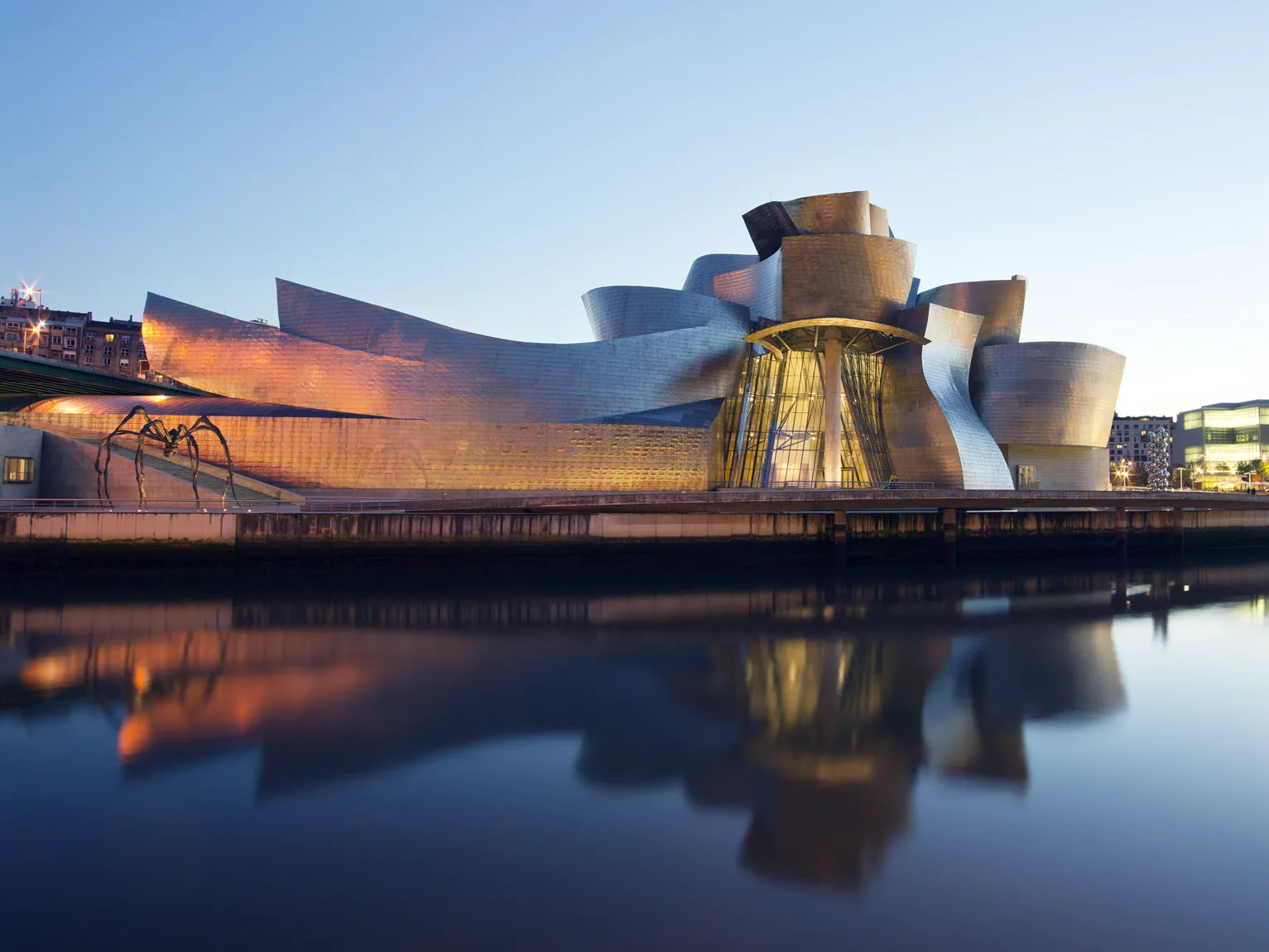
Most people visit the Guggenheim Bilbao for the building. They stand outside, take photos of the titanium curves reflecting off the river, and walk in expecting the art to match the architecture. Sometimes it does. Sometimes it doesn't. What never disappoints is the building itself, which Frank Gehry designed to feel like a ship docked along the Nervión.
In 3 minutes, you'll know:
- Which galleries deserve your time and which you can skip
- The permanent installation that justifies the visit even if temporary shows disappoint
- Practical tips on tickets, timing, and what to see outside
What makes the Guggenheim Bilbao different
This isn't a museum with a deep permanent collection like the Prado or the Picasso Museum in Barcelona. The Guggenheim Bilbao rotates most of its galleries with temporary exhibitions every few months. What stays permanent is Richard Serra's The Matter of Time in Gallery 104 — eight massive weathering steel sculptures that weigh over 1,000 tonnes combined — and the building itself.
The Atrium is the heart. A 50-metre-high skylight floods the central space with natural light, and three floors of galleries spiral around it. Jenny Holzer's Installation for Bilbao runs nine LED columns from floor to ceiling, scrolling text in Basque, Spanish, and English. Most visitors glance at them. Few stop to read.
The museum has 20 galleries spread across 11,000 square metres — ten rectangular, ten organic. Floor 3 houses works from the museum's own collection (Kiefer, Basquiat, Kapoor). Floor 2 hosts the major temporary exhibitions. Floor 1 is dominated by Serra. Outside, you'll find Jeff Koons' Puppy (a 12-metre dog covered in 60,000 flowers), Louise Bourgeois' Maman (a 9-metre bronze spider), and Fujiko Nakaya's fog sculpture that activates every hour for eight minutes.
1.3 million people visited in 2024 and 2025. Two-thirds were international visitors, mostly from France, Germany, the UK, and the US. It's the most visited museum in the Basque Country by a wide margin.
The Guggenheim Bilbao guide — on your phone inside the museum
- Floor-by-floor route with timing (skip the galleries that waste your time)
- Where to stand inside Serra's steel sculptures for the best effect
- The outdoor works 80% of visitors walk past without noticing
- Designed for your phone — open it inside the museum
What are the best works to see at the Guggenheim Bilbao?
Walk into Gallery 104 and let the scale hit you. Serra's The Matter of Time fills a gallery 130 metres long. The steel walls curve around you, narrowing and expanding. Walk through the corridors between the sculptures, not just around them. The sound changes. The light changes. This is the one room in the museum that everyone agrees on.
Stand under Jenny Holzer's LED columns in the Atrium. Nine vertical signboards, each over 12 metres tall, scroll fragments about intimacy, loss, and death. The text runs in three languages. It's easy to mistake them for decoration. They're not.
Look for the outdoor sculptures before you go in. Koons' Puppy sits at the main entrance. Maman is around the back, between the building and the river. Nakaya's fog sculpture is in the pool near the riverfront facade. If you arrive on the hour, wait for the fog — it lasts eight minutes.
Notice how Gehry used titanium on the exterior. The 33,000 panels were each cut to a different shape. On overcast days the building looks silver. In direct sun it turns gold. The best view is from the Puente de la Salve bridge, looking down at the building reflected in the river.
Compare what you see on Floor 3 with what's on Floor 2. Floor 3 is the museum's own collection: post-war and contemporary art that stays for extended periods. Floor 2 rotates completely. Visitors who love one floor often feel indifferent about the other.
What do most visitors wish they knew about the Guggenheim Bilbao?
Where to book
Our take: The Frank Gehry building is the bigger story than what's hung inside — even regular Guggenheim visitors say so. Budget 40 minutes outside before going in (the river-side approach is the real entrance). The official ticket (€18 to 12 October 2026, €12 from 13 October) is fine if you've done the reading. The €45 guided exterior tour is a different purchase, not a faster door. The old small-group tour earns it for first-time contemporary-art visitors who want context for Richard Serra's The Matter of Time — that's the room worth slowing down for — but it's a real premium over a ticket that already includes an audio guide.
The building is large but not as exhausting as it looks. The Atrium makes orientation easy: you can always see where you are relative to the centre. Start on Floor 1 with Serra, then take the elevator up.
Rainy days in Bilbao push crowds indoors. If it's raining, expect longer queues and fuller galleries. This is northern Spain — it rains a lot. Tuesday and Wednesday mornings are the quietest regardless of weather.
Free lockers are available for bags over 35 x 35 cm. Photography is allowed without flash or tripods.
The combo ticket (€16 from 14 October to 11 November 2026, the successor to the Artean Pass) covers both the Guggenheim and the Museo de Bellas Artes, a 5-minute walk away through Doña Casilda park. Bought separately the two cost €12 each. If you like classical and traditional art more than contemporary, the Bellas Artes may be the better museum for you. It reopened on 6 October 2026 after its expansion closure and its collections are free on Tuesdays, which is the one day the combo doesn't pay. See our Guggenheim + Fine Arts combo guide for the full route. For ticket details, free entry times, and the combo, see our Guggenheim Bilbao tickets guide.
The closest metro stop is Moyua (lines 1 and 2). Exit via "Ercilla-Guggenheim" and walk down Alameda Recalde towards La Salve bridge. About 10 minutes on foot.
Practical information
- Hours
- Tue–Sun 10:00–19:00. Extended to 20:00 in summer (Jun 15–Sep 13) and Easter week
- Price
- €18 adult to 12 Oct 2026, €12 from 13 Oct (varies with exhibitions). Half price students 18–25 & seniors 65+. Free under 18. Free 17–18 Oct 2026 (29th anniversary). Full ticket guide →
- Free entry
- No regular free day. 50% off from 16:00 on last day of each exhibition
- Metro
- Moyua (L1/L2, 10 min walk). Exit "Ercilla-Guggenheim"
- Audio guide
- Included with ticket (museum app). Bring headphones
- Guided tours
- GetYourGuide — €45, guided exterior tour, in English (4.7★, free cancellation)
- Website
- guggenheim-bilbao.eus
Hours and prices can change. Confirm on the official website before your visit.
Last verified: March 2026
Frequently asked questions
How long do you need at the Guggenheim Bilbao?
Most visitors spend 2 to 3 hours. If you're focused, 90 minutes covers the main galleries, Serra's installation, and the outdoor sculptures. Add 30 minutes if you want to explore the temporary exhibitions on Floor 2.
Is the Guggenheim Bilbao worth visiting?
Yes, but manage your expectations. The building itself is the main attraction — Frank Gehry's titanium exterior is worth the trip alone. The permanent Serra installation is extraordinary. The temporary exhibitions vary. If you only like classical art, the nearby Museo de Bellas Artes may suit you better.
When is the Guggenheim Bilbao free?
There is no regular free entry day. Under-18s always enter free. Reduced-price tickets (50% off) are available from 16:00 on the last day of each temporary exhibition. The combo ticket with the Museo de Bellas Artes costs €16 (14 October to 11 November 2026) and saves €8 on two separate tickets.
What is the best time to visit the Guggenheim Bilbao?
Tuesday to Thursday at the 10:00 opening, or after 16:00 on any weekday. The museum fills between 11:00 and 14:00, and the galleries around the Serra installation are where that shows first.
The slot nobody uses is Monday in summer. The Guggenheim closes most Mondays through the year, so visitors plan around it. But from 15 June to 7 September it opens every Monday, and a good number of people never find that out. Arrive at 10:00 on a July Monday and you get the calmest morning of the week in the busiest month of the year. The same applies to a handful of scattered Mondays: 30 March, 6 April, 12 October, 7 December and 28 December.
The other one is closing time in summer. From 15 June to 13 September, and during Easter week, the museum runs until 20:00 instead of 19:00. Tour groups have gone by 17:00 and the last ninety minutes are the emptiest stretch of the day. Bilbao eats late, so this costs you nothing socially.
And the day to avoid isn't a day at all, it's the weather. This is northern Spain and it rains a lot. A wet afternoon empties the Casco Viejo and fills the Guggenheim, because the locals go indoors too. If you're staying several days and have flexibility, spend the sunny morning on the riverside and save the museum for the day the forecast is good, not bad. Everyone does the opposite.
One trade-off worth knowing: on the final day of each temporary exhibition, admission drops 50% from 16:00. You save €9 in summer, and you share the rooms with everyone else who read the same thing.
The Guggenheim Bilbao is a building that happens to contain art. Some visits, the exhibitions will be the best thing you see all year. Other visits, you'll spend more time looking at the ceiling than the walls. Either way, the ceiling is worth it.
Already subscribed? Open the room-by-room guide →