Picasso Museum vs Miró Foundation: Which Barcelona Art Museum Should You Visit?
Honest side-by-side comparison of Barcelona's two biggest art museums. Collection, visit time, location, prices, and who each one is best for.
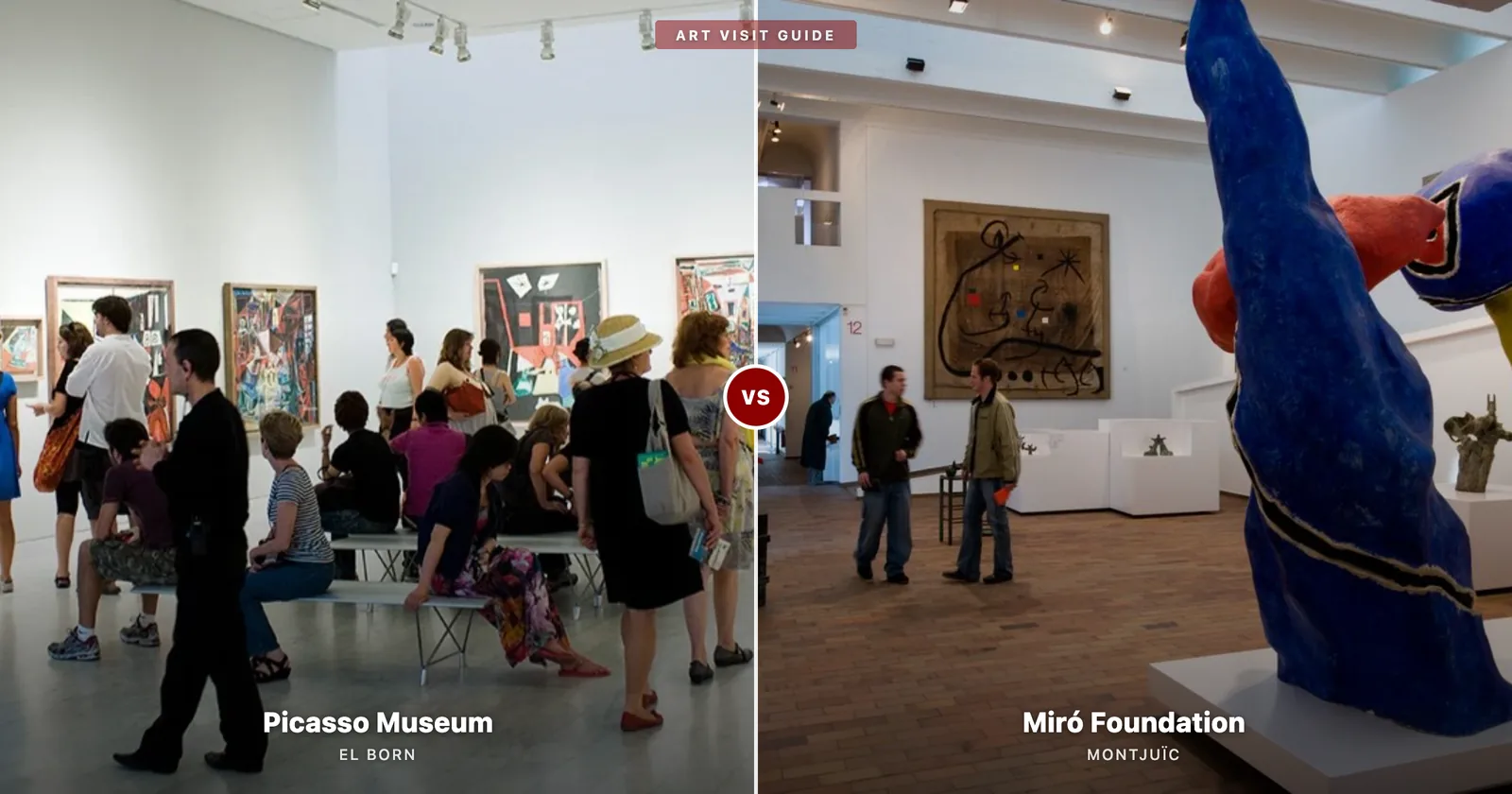
You have one afternoon and two museums pulling at you. One holds Picasso's teenage notebooks. The other houses Miró's private visual alphabet in a building designed to frame it. They're 4 km apart, completely different experiences, and most comparison guides just list facts without telling you which one to actually pick.
We've visited both dozens of times. Here's what nobody else will tell you. If you're comparing them with MNAC, that's a third entirely different angle on Catalan art.
In 3 minutes
- The Picasso Museum is about watching a genius learn. You see the student, the rebel, and the rule-breaker — in that order. No Guernica, no Cubist hits. Early works and the Las Meninas series
- The Miró Foundation is about a complete artistic world: art + architecture + light + views. Josep Lluís Sert designed the building as a conversation with the art. Most visitors miss the rooftop terrace
- Both take 90 minutes. Both cost under €20. But they reward different types of visitors. If you're doing both plus other museums, the Articket saves money with skip-the-line access
How do the Picasso Museum and Miró Foundation compare?
| Picasso Museum | Miró Foundation | |
|---|---|---|
| What you'll see | Early works, Blue Period, 58 Las Meninas variations. The artist's formation, not the celebrity. | 217 paintings, 178 sculptures, 9 tapestries. A full visual language built over 70 years. |
| The building | Five medieval palaces on Carrer Montcada. Narrow rooms, uneven floors, intimate. | White modernist building by Josep Lluís Sert. Mediterranean light, courtyards, rooftop terrace. |
| Location | El Born, city centre. Metro Jaume I (L4), 3 min walk. | Montjuïc hill. Bus 55/150 or walk from Espanya metro (15 min uphill). |
| Price | €14 online / €15 at door | €18 general / €12 reduced |
| Free days | 1st Sunday · summer Thu/Fri/Sat 7–9pm (Picasso Convida) · winter Thursdays 4–7pm. Book 4 days ahead. | Open Day: 12 Feb (Santa Eulàlia). No regular free day for adults. Free under 12. |
| Audio guide | €5 (physical device at museum) | Free — Bloomberg Connects app |
| Time needed | 90 min – 2 hours | 90 min – 2 hours |
| Photography | Yes, no flash | Yes, no flash/tripod/selfie stick |
| Crowds | Can be intense. Book online, use Montcada 17 entrance. | Quieter overall. Afternoons calmer than mornings. |
| Closed | Mondays · 1 Jan, 1 May, 24 Jun, 25 Dec | Mondays |
| Best for | Understanding an artist's evolution. Art history lovers. Central location. | The full experience: art + architecture + landscape. Quieter, contemplative visit. |
How do Picasso and Miró's artistic paths differ?
Picasso (1881–1973) left Barcelona as a young man and never came back. But the city kept his early work, and he chose Barcelona for his first dedicated museum. His friend Jaume Sabartés proposed it, and Picasso donated works directly — including all 58 Las Meninas paintings. This is the only Picasso museum that feels personal rather than curated.
Miró (1893–1983) was born in Barcelona and kept returning his whole life. Unlike Picasso's restless exile, Miró's relationship with Catalonia was constant. He chose Barcelona for his legacy. The Fundació opened in 1975 — and 2025-2026 marks its 50th anniversary, with a full year of special programming.
Both museums hold work that exists nowhere else. But the experience of visiting them is completely different.
Where to book
If you choose Picasso Museum:
If you choose Fundació Joan Miró:
Our take: GetYourGuide is worth it for Picasso — queues run 45–60 min without a ticket, especially after noon. Miró is quieter; the official site works fine, but GetYourGuide adds flexibility if your plans might change.
Which museum is best for your interests?
Go to the Picasso Museum if you:
- Want to understand how an artist becomes great — the progression from student to genius
- Are curious about the Blue Period (this is the best collection of it in the world)
- Like intimate, medieval architecture
- Prefer a central location you can walk to from most hotels
- Have limited time — El Born is easy to combine with lunch and neighbourhood walking
Go to the Miró Foundation if you:
- Care about the full experience — art, architecture, light, and landscape together. The Circles reorganization (March 2026) makes this connection even stronger, with the Cypress Garden now open for the first time
- Want a quieter museum visit (Picasso gets significantly more crowded)
- Enjoy abstract and contemporary art
- Are happy making the trip to Montjuïc (combine with MNAC, CaixaForum, or the gardens). In 2026, the Sagrada Família is also a Barcelona essential — the Tower of Jesus is now complete
- Want a free audio guide — the Bloomberg Connects app is genuinely good and costs nothing
Go to both if you:
- Have 2 days in Barcelona
- Bought the Articket (€38, covers both plus 4 more museums — saves you €35)
- Want the full picture of Barcelona's two greatest artists
What to look for
At the Picasso Museum
-
Stand in front of Aunt Pepa (Rooms 1-3). Picasso was 14. The precision is startling. This is why Cubism was a choice, not a limitation — he didn't reject realism because he couldn't do it.
-
Watch the mood shift in the Blue Period rooms. He stops painting what things look like and starts painting what they feel like. Most visitors walk past Rooftops of Barcelona in 3 seconds. Don't.
-
Sit with the Las Meninas room. 58 variations of the same Velázquez composition. Don't rush. Watch him deconstruct it over and over until it becomes something entirely his.
At the Miró Foundation
-
Notice how the light changes between rooms. Sert designed it this way on purpose. The architecture doesn't compete with the art — it frames it. Afternoon light is warmer, softer.
-
Find the Mercury Fountain by Alexander Calder. Most visitors walk past it. It was built as a political protest for the 1937 Paris Exposition, alongside Guernica. It runs on actual mercury — toxic and mesmerising.
-
Go to the rooftop terrace. It's included in your ticket and most visitors miss it entirely. Miró sculptures, city views, orange trees. Worth 15 minutes of your visit.
Tips most sites won't tell you
-
Picasso gets crowded after noon. Weekday mornings at 10am are your best window. Tuesdays and Wednesdays are quietest. Free Thursdays sound tempting but are packed — book your free slot 4 days in advance (they release Sunday at 10am and go fast). For paid tickets, see how to book Picasso Museum tickets — €14 online vs €15 at the door.
-
At Miró, download the Bloomberg Connects app before you arrive. It's a genuine audio guide, not a marketing brochure — covers major works, the building, and temporary exhibitions. Wi-Fi at the museum is free, but you'll waste 10 minutes setting it up on site. Do it at the hotel.
-
If you're doing both in one day, do Picasso in the morning and Miró in the afternoon. Picasso is central — walk to lunch in El Born. Miró is quieter after 2pm, golden light on Montjuïc, and you can combine with sunset views from the terrace.
-
The Articket saves real money. €38 for both museums plus MNAC, MACBA, Tàpies, and CCCB. That's €35 saved if you visit all six. Valid for 12 months, so no rush.
Frequently asked questions
Should I visit Picasso Museum or Fundació Joan Miró?
Choose based on what you want: Picasso Museum shows an artist's evolution and takes 90 minutes in the city centre. Miró Foundation offers a complete experience with architecture, light, and landscape on Montjuïc. If you have time, visit both.
How much do Picasso Museum and Miró Foundation cost?
Picasso Museum is €14 online/€15 at the door. Miró Foundation is €18 general admission. Both are included in the Articket Barcelona pass (€38 for 6 museums), which saves money if you visit at least 3 of the 6 venues.
Which museum is less crowded: Picasso or Miró?
Miró Foundation is significantly quieter, especially in the afternoons. Picasso Museum gets crowded after noon; weekday mornings at 10 AM are the best window. On free days, Picasso is packed while Miró remains relatively calm.
How do I get to the Miró Foundation from Picasso Museum?
They are 4 km apart. From Picasso Museum in El Born, walk to Jaume I metro (L4) and transfer to Espanya (L1/L3), then walk 15 minutes uphill through Montjuïc. Alternatively, take a taxi for about €10.
Can I visit both museums in one day?
Yes, ideally visit Picasso in the morning (90 minutes) and Miró in the afternoon (90 minutes). Walk to lunch in El Born after Picasso, then head to Miró where afternoon light is warmer and fewer school groups visit.
Practical info
Picasso Museum
Miró Foundation
Hours and prices can change. Confirm on official sites before you go.
Last verified: June 2026
These aren't competing museums. They're complementary. Picasso shows you how an artist learns to break rules. Miró shows you the world he built after breaking them. If you only have time for one, pick the experience that matches what you're looking for — not the bigger name.
- Picasso Museum Barcelona — What to See & How to Visit
- Fundació Joan Miró Guide
- MNAC Romanesque Collection Guide
- Museu Tàpies Barcelona Guide
- MACBA Barcelona Guide
- Picasso Museum: Tickets, Hours & Tips