What to See at the Vatican Museums: A Practical Visitor's Guide
54 galleries, 7 kilometres, 70,000 works. Here's what's actually worth your two and a half hours, and what to skip.
The Vatican Museums hold roughly 70,000 works across 54 galleries. Most visitors see maybe 200 of them in 2.5 hours, then leave overwhelmed. The trick is knowing which 200, in what order, and where to slow down. This is the highlights route worth your time.
What are the Vatican Museums actually like?
Picture 7 kilometres of connected galleries, painted ceilings overhead in almost every room, and a single one-way route that ends at the Sistine Chapel. The official path passes through ancient Roman sculpture, an Egyptian collection, two long tapestry corridors, the 120-metre Gallery of Maps, four rooms frescoed by Raphael, and finally the chapel Michelangelo painted twice: once on the ceiling, once on the wall behind the altar.
You cannot backtrack after the Sistine Chapel. That single rule shapes the whole visit: skip a room early and you lose it. The collection is so vast that even a 5-hour visit only covers maybe 10% of what's on display. Trying to see everything is the most common mistake. Pick the three or four sections that matter to you and walk through the rest without guilt.
Where to book
Our take: Official at €25 (€20 on-site + €5 online fee) is cheaper but the Vatican's own site is slow and often shows nothing available for the next 2-3 days. GetYourGuide holds its own inventory, which is what the extra €8 buys. It is not flexibility: the ticket is non-refundable, so book it when your dates are set. See the full tickets guide for tour comparisons.
What to look for, room by room
The Laocoön (Pio-Clementino, Octagonal Courtyard). Found in a Roman vineyard in 1506. When Michelangelo saw it, he reportedly ran to the site barefoot. Stand back three metres to see the full pyramid composition, then step closer: the snake scales are individually carved, and the three figures suffer at different stages. One son is already dying, the other still fights.
The Gallery of Maps ceiling. Everyone photographs the wall maps. Look up instead. The barrel vault is frescoed with landscapes, allegories, and grotesques that rival anything else in the building. It's also one of the few corridors where you can hear yourself think.
The Room of the Segnatura (Raphael Rooms). The School of Athens covers an entire wall. Follow the perspective lines: they converge between Plato and Aristotle. Raphael modelled Plato's face on Leonardo da Vinci. In the lower right corner, he painted himself: a young man in a black cap looking directly at you. Rooms 3 and 4 are mostly workshop and worth a quick walk-through.
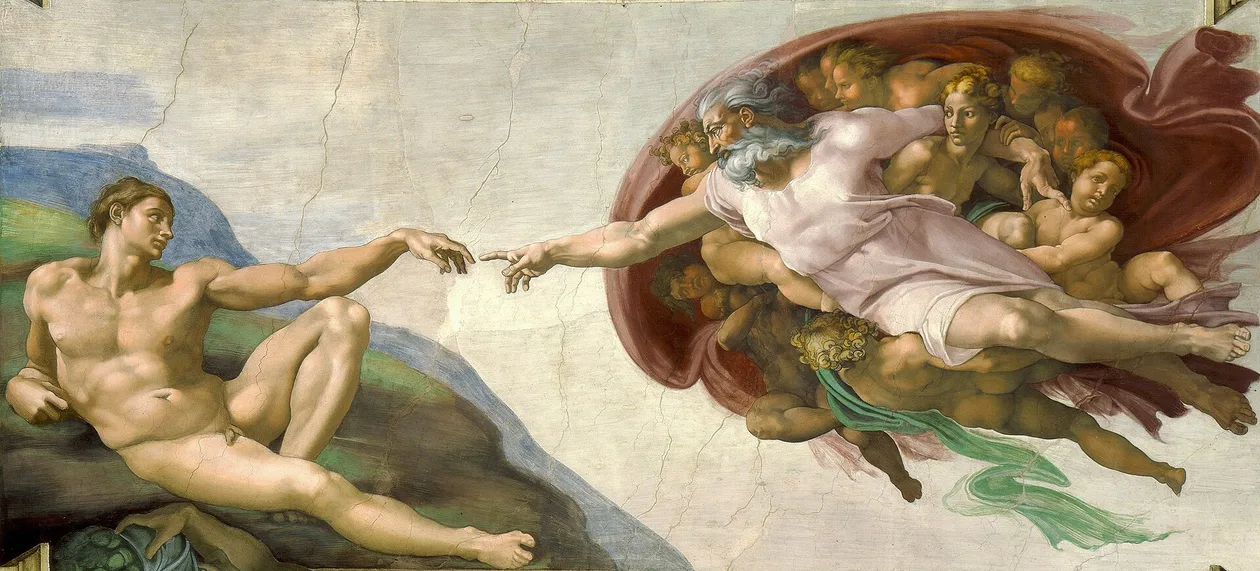
The Sistine Chapel ceiling. Michelangelo painted fake architectural frames that make the flat surface appear three-dimensional. The 20 nude figures (ignudi) around the edges are studies in anatomy and movement. The Creation of Adam is in the centre: God reaches out and Adam stays passive. Notice the contrast: God is muscular, surrounded by figures. Adam is alone.
The Last Judgment wall. Painted 25 years after the ceiling, when Michelangelo was 60. Christ in the centre is a young athlete, not the bearded judge of medieval tradition. The damned fall on the right, the saved rise on the left. Saint Bartholomew holds his own flayed skin, and the face on the skin is Michelangelo's self-portrait.
Get the room-by-room Vatican Museums guide
- 3-step route with timing for each section
- What to notice at the Laocoön, School of Athens, and Sistine ceiling
- 4 insider tips including the St. Peter's exit shortcut
Tips most sites won't tell you
Walk fast through the Egyptian and Etruscan rooms. They're between the entrance and the sculpture courtyard. Unless you came specifically for them, they slow you down before the parts you actually want to see. Five minutes total is fine.
The 8 AM slot is transformative. The first 30 minutes inside the museum are different from the rest of the day. Galleries are half-empty. The Sistine Chapel by 9:30 holds maybe 200 people; by 11:00 it holds 2,000. In past summers, Friday evening openings were the other quiet window, but the official site lists none for 2026.
The Sistine Chapel exit leads into St. Peter's Basilica. The group exit (left side as you face the Last Judgment) bypasses 30 minutes of backtracking and a separate security queue. Most independent visitors miss this and exit through the main route. The basilica is free.
What to skip if you're tight on time
If you only have 2 hours, skip the Pinacoteca, the modern religious art, and most of the tapestry corridor. Walk straight to Pio-Clementino, give 20 minutes to the Octagonal Courtyard, then move through the Gallery of Maps without stopping for photos, give the Raphael Rooms 25 minutes (mainly the Room of the Segnatura), and arrive at the Sistine Chapel with 25 minutes to spare.
If you have 3.5 hours, add the Pinacoteca first (Caravaggio's Entombment and Raphael's Transfiguration are worth it) and the full Gallery of Maps with the ceiling.
If you have a full day, you're still not seeing everything. Pace yourself, take breaks in the courtyards, and accept that the Vatican Museums are designed to be returned to.
- Museum
- Vatican Museums & Sistine Chapel
- Highlights route
- 2.5 to 3 hours
- Full visit
- 4 to 5 hours (includes Pinacoteca + Egyptian)
- Hours
- Mon–Sat 8:00 AM – 8:00 PM (last entry 6 PM)
- Friday nights
- None listed for 2026 on the official site
- Closed
- Sundays (except the last of each month, which is free entry), major holidays
- Dress code
- Shoulders and knees covered, enforced at entry
- Photos
- Allowed without flash, except in the Sistine Chapel
- Metro
- Ottaviano (Line A) — 5 min walk
- Website
- museivaticani.va
- Tickets
- GetYourGuide (from €33, skip-the-line) · museivaticani.va (€25 online)
Hours and rules can change — confirm on the official site before you go.
Last verified: April 2026
Frequently asked questions
What are the top highlights at the Vatican Museums?
Three works define the visit: the Laocoön group in the Pio-Clementino courtyard (1st-century Roman sculpture that shaped the Renaissance), Raphael's School of Athens in the Room of the Segnatura (1509-1511), and Michelangelo's Sistine Chapel ceiling and Last Judgment (1508-1541). Add the Gallery of Maps for one of the most beautiful corridors in Rome.
How long does it take to see the Vatican Museums highlights?
A focused highlights route takes 2.5 to 3 hours: 25 minutes in Pio-Clementino, 50 minutes through the Gallery of Maps and Raphael Rooms, 25 minutes in the Sistine Chapel, plus walking time between sections. Adding the Pinacoteca or Egyptian Museum pushes it to 4-5 hours. For timings by route and by season, see how long the Vatican Museums take.
What should I skip at the Vatican Museums?
If your time is limited, skip the Egyptian Museum (Room 4 onwards), the modern religious art collection, and the Etruscan rooms. The route is one-way after the Sistine Chapel, so prioritize Pio-Clementino, Gallery of Maps, Raphael Rooms, and Sistine Chapel. The Pinacoteca is worth it only if you have an extra hour and arrive early.
Are the Sistine Chapel paintings really by Michelangelo?
Yes. Michelangelo painted the ceiling between 1508 and 1512 (commissioned by Pope Julius II) and the Last Judgment wall between 1536 and 1541 (commissioned by Pope Paul III). He worked mostly alone, lying on scaffolding, and left detailed records. The frescoes were cleaned and restored between 1980 and 1994.
What is the best order to visit the Vatican Museums?
The official route is one-way and pre-set: Pio-Clementino (sculptures) → Gallery of Maps → Tapestries → Raphael Rooms → Sistine Chapel. You cannot reverse direction after the Sistine Chapel, so do not skip the Raphael Rooms hoping to come back. If you want the Pinacoteca, see it first. It's a separate wing near the entrance.
Need tickets? See the Vatican Museums tickets guide for prices, free days, and skip-the-line options. Choosing between sights? Read Colosseum vs Vatican — which first?. Planning a wider Rome trip? Start with the best art museums in Rome or check which Rome museums are free in 2026. After the Vatican, the St. Peter's Dome climb is a 10-minute walk and the best view in the city. Before you go, check the Vatican Museums dress code — covered shoulders and knees, checked at security.
Already subscribed? Open the room-by-room guide →
- Vatican Museums Tickets 2026: Prices & Skip-the-Line
- Colosseum vs Vatican — Which First?
- Best Art Museums in Rome for First-Time Visitors
- Free Museums in Rome 2026
- St Peter's Dome Climb Guide
- Vatican Museums Dress Code: What to Wear