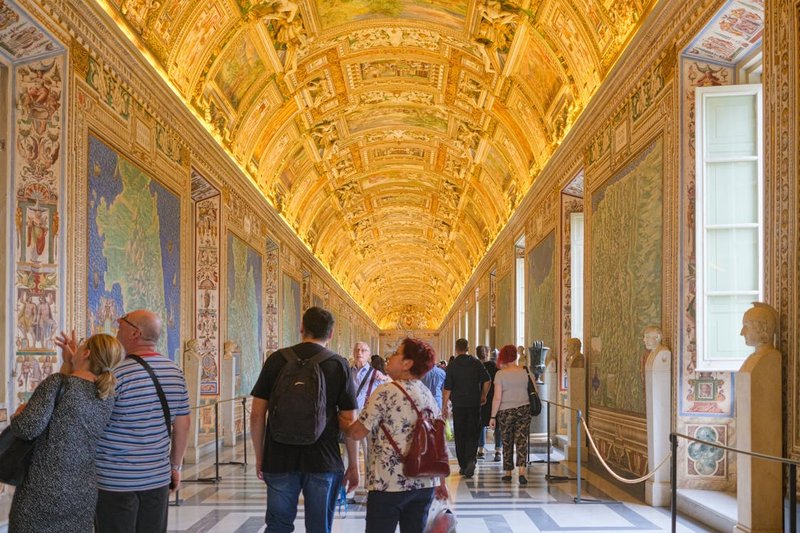
54 Galleries. 7 Kilometres. One Ceiling That Changed Art Forever.
A room-by-room route through the Vatican Museums — from ancient sculpture to the Sistine Chapel.
Get your free guide
Enter your email to unlock the full room-by-room guide. One email unlocks all Rome museum guides.
Free · No spam · Unsubscribe anytime
Most visitors follow the crowd straight to the Sistine Chapel. Slow down. The Gallery of Maps is half-empty and twice as beautiful. The Raphael Rooms reward anyone who stops to read the walls.
Head to the Octagonal Courtyard for the Laocoön group and the Apollo Belvedere. These two works set the standard for Renaissance sculpture. The courtyard gets packed by 10:30 AM. Arrive early or push through quickly and return if time allows.
120 metres of 16th-century painted maps lead into four rooms frescoed by Raphael. The Gallery of Maps is one of the most beautiful corridors in Rome — look up at the vault, not just the walls. In the Raphael Rooms, focus on the Room of the Segnatura: The School of Athens covers the entire wall. Rooms 3 and 4 are mostly workshop and less essential.
Michelangelo's ceiling (1508–1512) and the Last Judgment wall (1536–1541). No photos allowed. No talking above a whisper. Position yourself near the side walls when you enter. Let the crowd flow to the centre, then look up.
The first 30 minutes inside are transformative. By 10 AM, the galleries hold 10x more people. Friday nights (April–October) are the other quiet window.
The group exit from the Sistine Chapel leads directly into St. Peter's Basilica. It saves 30 minutes of backtracking and a separate security queue.
The museum route is one-way. Once you leave the Sistine Chapel, you cannot go back. See everything you want before reaching it.
Dress code is enforced at the entrance. No bare shoulders, no shorts above the knee, no tank tops. Bring a light scarf in summer.
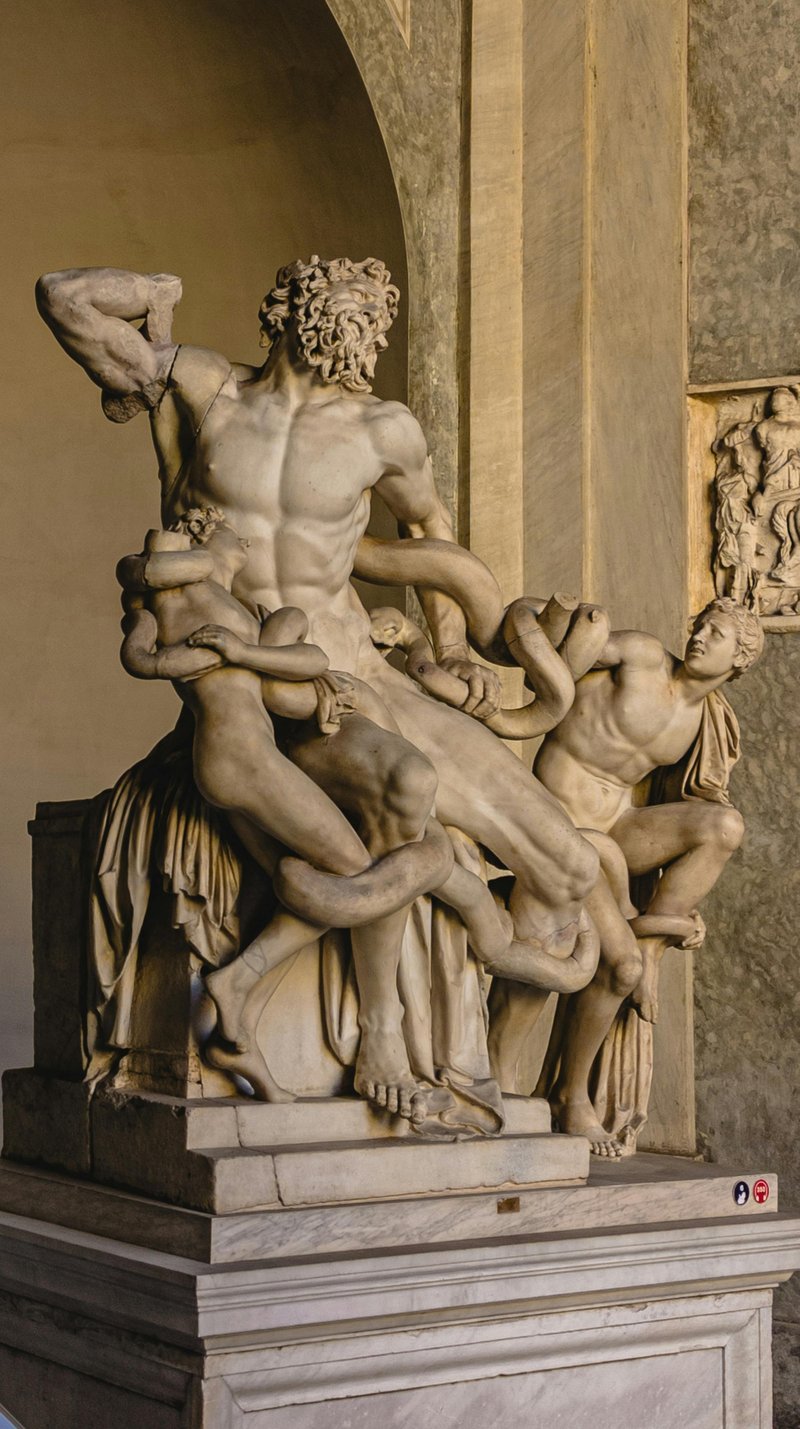
Why it matters: A Trojan priest and his sons attacked by sea serpents. Found in a Roman vineyard in 1506, it stunned Michelangelo and reshaped Renaissance sculpture overnight.
What to notice: Stand back three metres to see the full pyramid composition. Then step closer: the snake scales are individually carved, and the three figures suffer at different stages. One son is already dying, the other still fights. Laocoön's face is agony, not heroism.
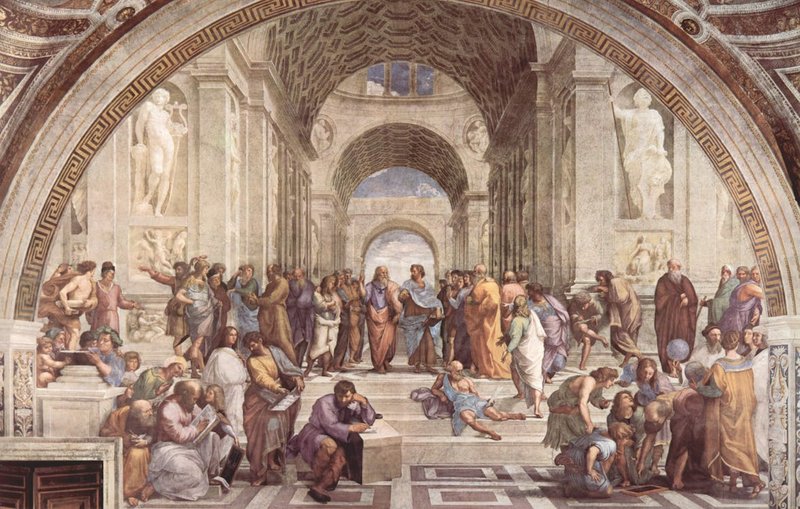
Why it matters: Fifty philosophers gathered in one impossible room. Plato points up (abstract truth), Aristotle points down (observed reality). Raphael modelled Plato's face on Leonardo da Vinci.
What to notice: Follow the perspective lines. They all converge between Plato and Aristotle. The architecture behind them was inspired by Bramante's design for St. Peter's. Look at the lower left: Pythagoras writes on a tablet. Lower right: Euclid draws a geometric proof. Raphael painted himself in the far right corner.
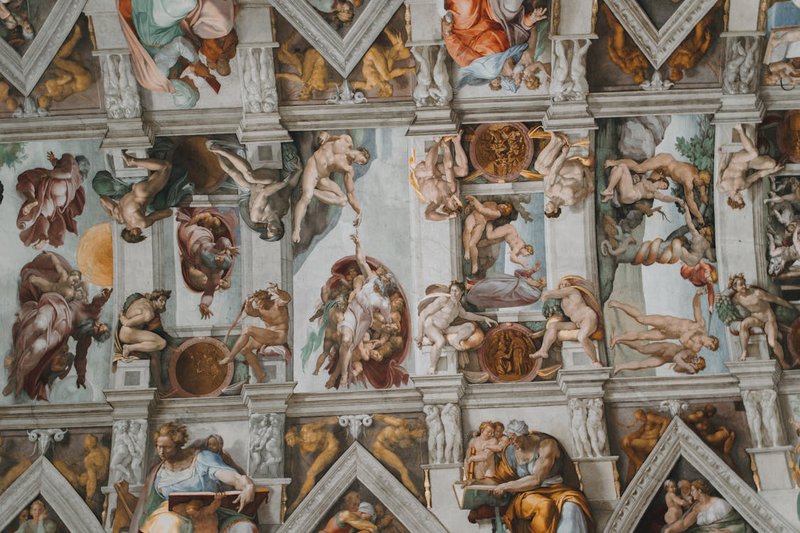
Why it matters: The most reproduced image in Western art. God reaches out to a reclining Adam. Their fingers nearly touch but never do. Michelangelo left the gap intentional.
What to notice: Look at the contrast: God is muscular, active, surrounded by figures. Adam is limp, passive, alone. Now look at the entire ceiling. Michelangelo painted fake architectural frames that make the flat surface appear three-dimensional. The 20 nude figures (ignudi) around the edges are studies in movement and anatomy.
How well did you look?
3 quick questions about what you just saw
Visit complete!
Share your visit or save it for later
Your collection