Visiting the Prado Museum with Limited Mobility: What Works (2026)
The Prado is one of Europe's most accessible major museums — but you have to know which entrance to use and what to ask for at the desk.
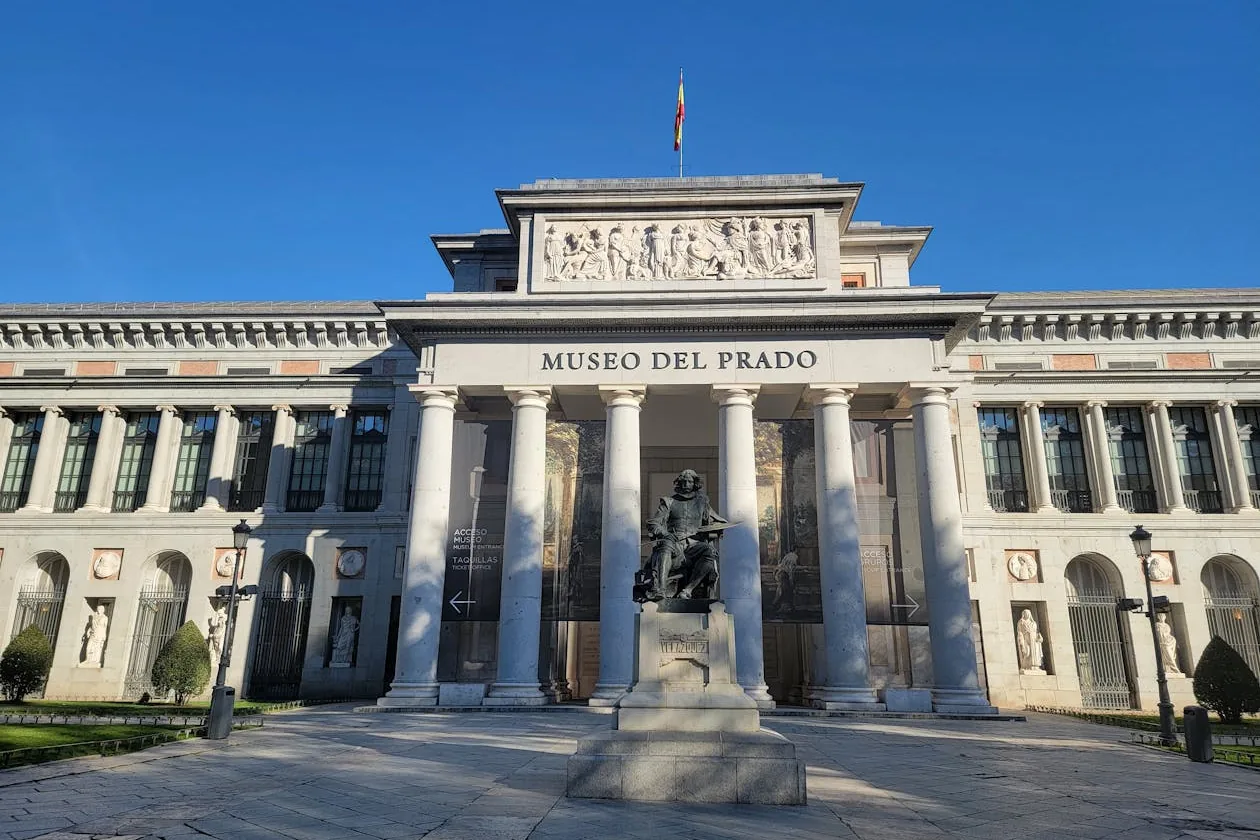
Most Prado guides give accessibility a sentence at the end: "the museum is wheelchair accessible." True, but it skips the part that actually matters — which entrance to use, what to ask for at the desk, and what the visit feels like in practice. This is that version.
If you or someone you're travelling with has limited mobility, the Prado is one of the easier major European museums to visit. The infrastructure is solid. The signage isn't.
In 3 minutes
- Use the Jerónimos entrance, not Goya — it's the wheelchair entry and gives priority access.
- Disabled visitors and one companion enter free with proof of disability.
- Wheelchairs are loaned free at the cloakroom, first-come, first-served.
- The 10-masterpiece accessible route covers the headlines without stairs.
Get the room-by-room guide
Which Prado entrance should you use?
The Prado has five entrances: Jerónimos, Velázquez, Goya Alta, Goya Baja, and Murillo. Search engines and Google Maps default first-time visitors to the Goya entrances (the front, on Paseo del Prado) because those are the most photographed. They have steps.
Puerta de los Jerónimos is on the back side, off Calle de Ruiz de Alarcón, behind the church. It's the official wheelchair entrance and gives priority access to visitors with reduced mobility — straight to ticket offices 1 and 2, then into the building without queueing. From the metro, exit at Banco de España (Line 2) or Atocha (Line 1) and walk around to the back. About 7-10 minutes either way.
If you arrive at the Goya entrance by mistake, security will redirect you to Jerónimos. That's a 5-minute walk around the building. Not a disaster, but avoidable.
What to ask for at the desk
Three things, in order:
1. Free entry with proof of disability. A national disability card, EU Disability Card, or equivalent gets you in free, plus one companion or carer. This is independent of the museum's 18:00–20:00 free slot, so you can use it during peak hours when the queue is shorter than the free crush at the end of the day.
2. A wheelchair, if needed. The cloakroom loans wheelchairs and strollers for free. First-come, first-served, no advance booking. Quantities are limited, so arriving 15 minutes early matters during peak season (March–October). If they're out, the closest external rental is through services like Motion4Rent — book 24+ hours ahead.
3. The accessible audio guide. Two services exist that the regular ticket desk won't mention unless asked. Audio description for 53 masterpieces (richer narration with visual descriptions, free at the Audio Guide desk). Signoguides with Spanish Sign Language (LSE) and subtitles for 52 works. Either one transforms a self-guided visit if standard text panels are difficult.
The accessible route, honestly
The museum's 10-masterpiece accessible route is the version we'd recommend even for visitors without mobility constraints — it's the highlights without the corridor backtracking. Pick up the printed map and Easy Read leaflet at the Information desk inside.
Two hours is enough. Don't try to cover the full collection — the museum holds thousands of works across multiple floors, and the long way around adds 90 minutes of slow gallery navigation that the curated route avoids.
What still doesn't work well
Three honest gaps. The Prado's infrastructure is genuinely good for a museum of its age (1819 building), but it isn't perfect.
Bench density is uneven. Most rooms have at least one bench, but the long Velázquez and Goya galleries have stretches without seating. Plan rest points by entering and exiting these galleries via the central halls — where benches cluster — rather than walking them end to end.
Audio guide loan can run out. Peak season (Easter week, July, August) drains the descriptive audio guides by 11:00. If accessibility audio matters, book the first morning slot (10:00) and head to the Audio Guide desk before entering the galleries.
Restroom distances vary. Accessible restrooms exist on every floor but are concentrated near the central staircase. The far ends of the Goya and Velázquez wings are a longer walk from the nearest accessible toilet than the central rooms. Build that into the route, especially if you're visiting longer than two hours.
Quick reference
- Wheelchair entrance
- Puerta de los Jerónimos (back, Calle de Ruiz de Alarcón)
- Free entry
- Disabled visitors + 1 companion (proof required)
- Wheelchair loan
- Free at the cloakroom · first-come, first-served
- Audio guide accessible
- Audio description (53 works) · Signoguide LSE (52 works)
- Accessible route
- 10-masterpiece map + Easy Read leaflet at Information desk
- Closest metro
- Banco de España (L2) or Atocha (L1) · 7-10 min walk to Jerónimos
- Recommended duration
- 2 hours via accessible route
- Best slot
- 10:00 morning (audio guide stock + cooler galleries)
Hours, services, and audio guide stock can change. Confirm on the official accessibility page before you go.
Last verified: May 2026
Frequently asked questions
Is the Prado Museum wheelchair accessible?
Yes, fully. The museum has lifts, ramps, accessible toilets, and step-free routes throughout. The Jerónimos entrance at the back of the building is the dedicated wheelchair entry. Wheelchairs are available on loan at the cloakroom — first-come, first-served, no booking. Plan to arrive 15 minutes before your timed slot to collect one without delay.
Where is the wheelchair entrance at the Prado Museum?
The Puerta de los Jerónimos, on the back (west) side of the building facing Calle de Ruiz de Alarcón. Most signage and Google Maps point first-time visitors to the Goya entrances, which have steps. If you have limited mobility, ignore those and go straight to Jerónimos — the museum gives priority access there to visitors with reduced mobility.
Is the Prado Museum free for disabled visitors?
Yes. Disabled visitors enter free, plus one companion or carer. You'll need to show proof of disability (national disability card, EU Disability Card, or equivalent) at ticket offices 1 or 2, which give priority access. The free entry is independent of the museum's general 18:00–20:00 free slot.
Does the Prado offer accessible audio guides?
Two services. Standard audio guides have audio description for 53 masterpieces (free at the Audio Guide desks — ask specifically for the descriptive version, not the regular one). For deaf and hard-of-hearing visitors, Signoguides offer videos in Spanish Sign Language (LSE) with subtitles for 52 masterpieces. The auditorium and ticket counters also have an induction loop system.
Is there a recommended accessible route at the Prado?
Yes. The museum publishes a 10-masterpiece accessible route with a step-free map and an Easy Read leaflet, both available at the Information desks. It covers the museum's headline works — Velázquez's Las Meninas, Goya's Black Paintings, Bosch's Garden of Earthly Delights — without backtracking through stairs or narrow galleries. Two hours is enough.
This is current information at time of writing, sourced from the official Prado accessibility page and from visitor reports. Services and infrastructure can change without notice — if you're planning a visit and any of these details matter, confirm with the Prado's accessible visit page or call the museum directly. Sources: museodelprado.es, esmadrid.com Paseo del Arte for disabled visitors, Wheel the World Madrid guide.
For the rest of Madrid: our Prado visit guide covers the standard visit, and the Madrid museum tickets post compares all major museums in the city. If you're combining the Prado with Reina Sofía and Thyssen, the Prado vs Reina Sofía comparison helps prioritize when time matters.
Already subscribed? Open the room-by-room guide →
- Prado Museum Madrid: Visit Guide
- Madrid Museum Tickets 2026
- Prado vs Reina Sofía: Which Madrid Museum to Visit
- Madrid Museum Opening Hours 2026
- Free Museums in Madrid 2026

Or skip the planning: I'll do it for you
Send me your dates. I’ll plan which museum goes on which day, around closures, free days and timed entries, and check every date against the official museum sites myself. In your inbox the same day.
 Planned by Adrià, who writes these guides