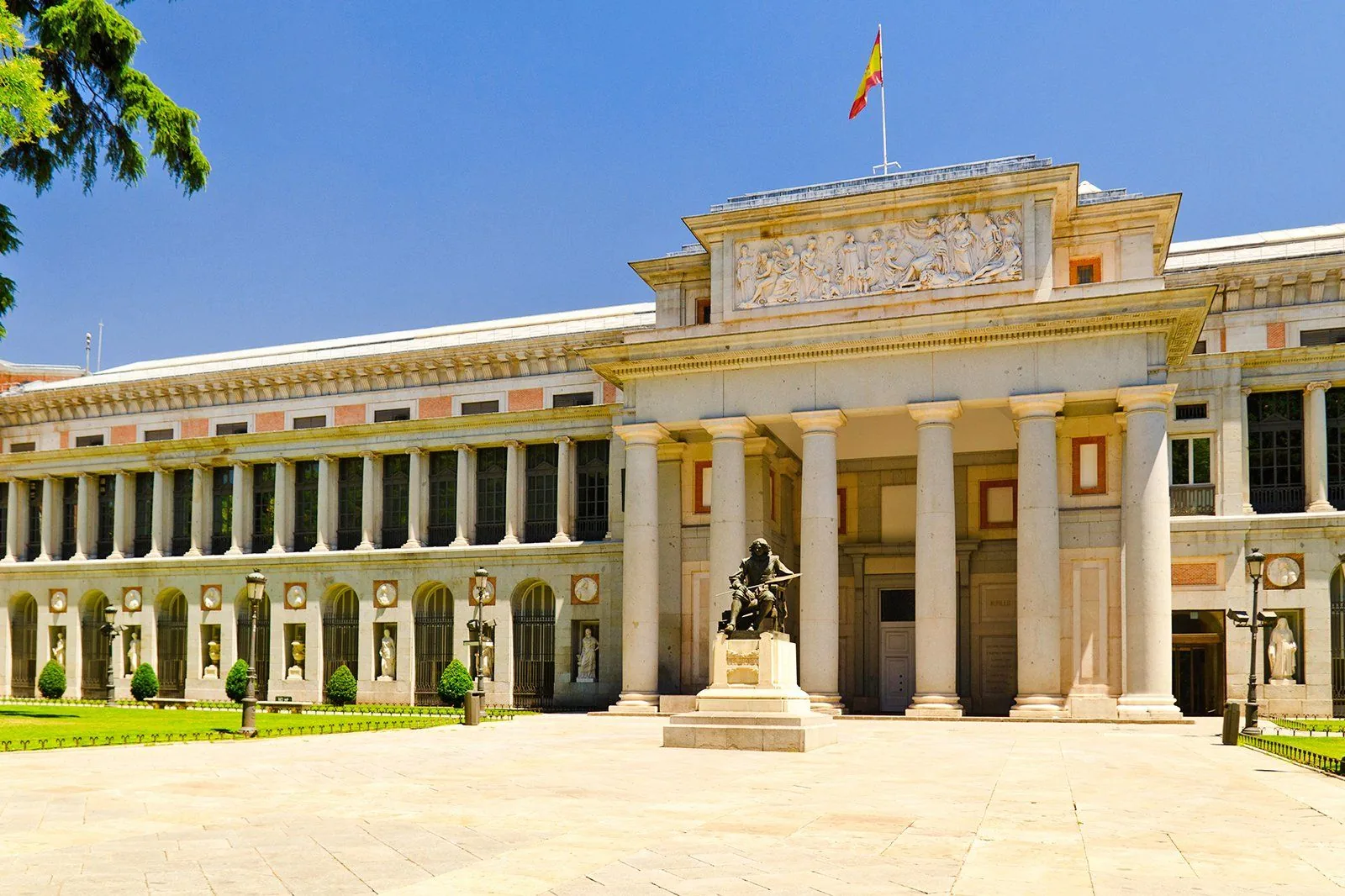
800 Years of European Painting in One Building
A room-by-room route through the Prado — from Bosch's nightmares to Goya's darkness.
Get your free guide
Enter your email to unlock the full room-by-room guide. One email unlocks all Madrid museum guides.
Free · No spam · Unsubscribe anytime
Most people go up to Las Meninas first. Don't. Start on Floor 0 with Bosch, and the contrast when you reach Velázquez is the whole visit.
Start at Room 56A with Bosch's Garden of Earthly Delights, then work the same corridor instead of leaving it. Room 55A has Bruegel's Triumph of Death and Patinir's Charon crossing the Styx, Room 55B has Dürer's self-portrait, Room 56B has Fra Angelico's Annunciation, and Room 58 has Van der Weyden's Descent from the Cross. Six of the best things in the building inside four rooms, and they stay quiet because the queue goes straight upstairs to Velázquez.
Room 12 is Las Meninas and it is the one room worth standing still in. Before it, Room 8B has El Greco's Nobleman with his Hand on his Chest and Room 9 has Ribera; after it, Room 16 has Murillo's Immaculate Conception of Los Venerables and Room 29 has Rubens's Three Graces. Titian is further east than most people walk, Rooms 41 to 44, with The Andrians in Room 42. Room 27 is not Titian: it is Leoni's bronze of Philip II.
Goya is split across two floors and the museum does not make that obvious. The court portraits are upstairs, Rooms 32 to 38, with The Family of Charles IV in 32 and The Naked Maja in 38. But The 3rd of May 1808 is downstairs in Room 64, and the Black Paintings are in Rooms 66 and 67, with Saturn in 67. Walking up for the court and back down for the executions is his whole life in two staircases.
The east entrance is consistently less crowded than the main Velázquez door.
Siesta hours. Tour groups leave for lunch. Las Meninas room gets almost empty.
Permanent collection is photo-free. Put the phone away and actually look.
Large bags are mandatory to check. Do it even with small ones — you'll walk 3+ km inside.

Why it matters: Velázquez paints himself painting the king, the princess watches, and so do you. It is the room the rest of Floor 1 is arranged around.
What to notice: Stand directly in front and step slowly to the right. The mirror in the back changes who the painting is 'for.' Notice how Velázquez places himself at the same scale as royalty.

Why it matters: A triptych painted 500 years ago that still feels like nothing else. Paradise, pleasure, and hell in three panels.
What to notice: Read it left to right like a story. The left panel is calm, the center is chaotic joy, the right is punishment. Look at the scale of humans versus objects — strawberries the size of people.

Why it matters: The first modern war painting. Goya drops heroism entirely — this is terror, not glory.
What to notice: The soldiers have no faces, and the only light source in the painting is the white shirt. Then look at the ground to the left: the man already shot is painted at the same scale and with the same care as the one still standing, which is the part that had no precedent.
How well did you look?
3 quick questions about what you just saw
Visit complete!
Share your visit or save it for later
Your collection