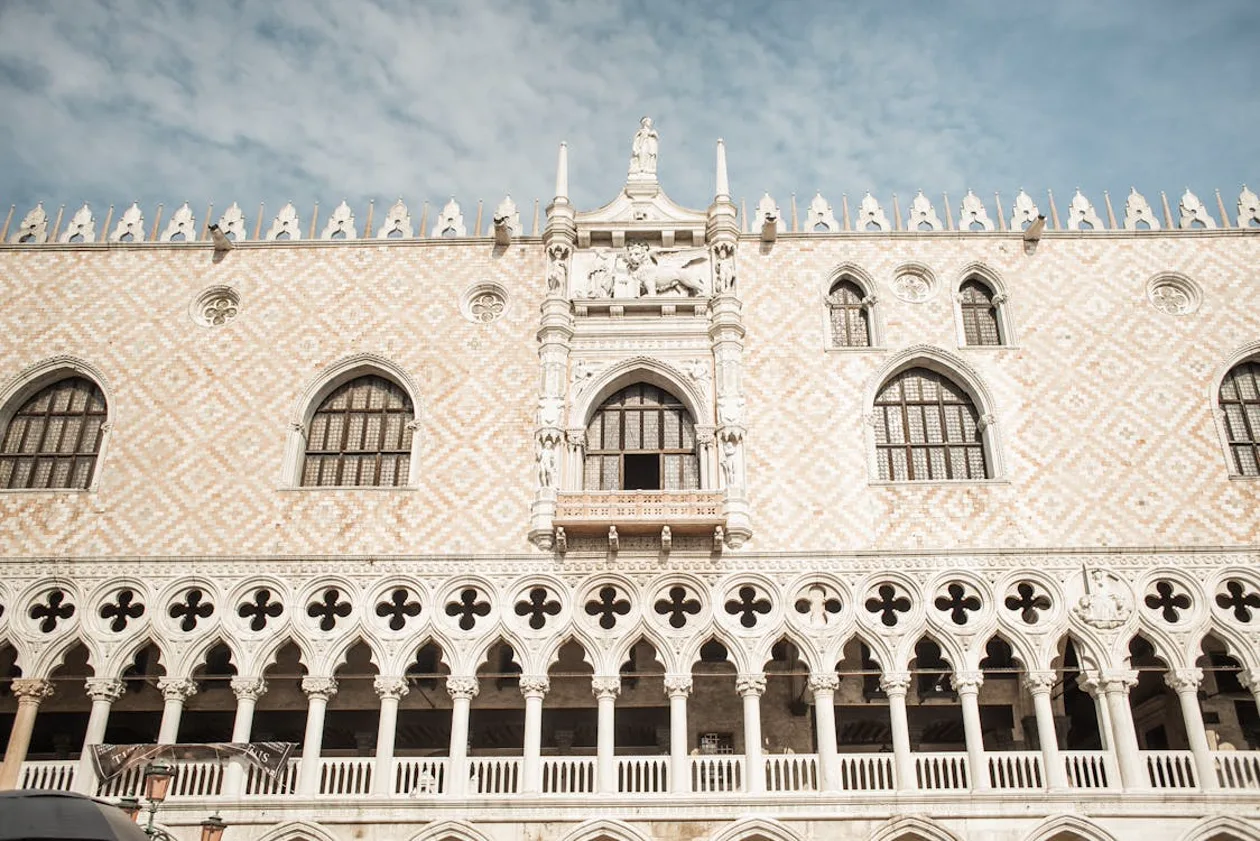
1,100 Years of Power. Two Hours to See It.
A room-by-room route through the Palazzo Ducale — the Great Council Hall, Tintoretto's Paradise, and what happens when you cross the Bridge of Sighs slowly.
Get your free guide
Enter your email to unlock the full room-by-room guide. One email unlocks all Venice museum guides.
Free · No spam · Unsubscribe anytime
The Great Council Hall was designed to make foreign ambassadors feel small. It worked. Go straight to the second floor. The Hall holds the largest oil painting on canvas ever made — 22.6 metres of Tintoretto. Walk to the far wall before you look back. The perspective changes everything.
Enter through the main gate on the lagoon side. The courtyard is one of the finest in Venice — Renaissance arches, two ornate well-heads, the Arco Foscari overhead. The Giants' Staircase (Scala dei Giganti) rises at the far end, flanked by Jacopo Sansovino's massive statues of Mars and Neptune — the sea and land power of the Republic personified in marble. Every new Doge was crowned at the top of these stairs, in public, before the assembled nobles of Venice. The scale is not accidental. The staircase was built to be visible from the entrance — a statement of permanence seen by every visiting dignitary before any negotiation began.
The Sala del Maggior Consiglio held up to 2,000 Venetian nobles for votes. Walk the full length before you look back. From the far wall, Tintoretto's Paradise fills the entire space opposite — 22.6 by 9.1 metres, the largest oil painting on canvas in the world. From the entrance, it reads as a crowded blue canvas. From here, it resolves into a hierarchy of heaven, angels, saints, and Christ in concentric rings of gold. Tintoretto painted it at 70, with his son Domenico. He won the commission against Veronese and Bassano by submitting a finished ceiling sketch — then delivered a work they hadn't anticipated. Look up before leaving: Veronese's ceiling panels are directly above. Use your phone camera pointed upward or you will spend the next 20 minutes with neck pain. The Senate Hall (Sala del Senato) next door is smaller and often quieter — the red-and-gold ceiling took 30 craftsmen six years.
The Ponte dei Sospiri was completed in 1614, connecting the palace to the New Prisons (Prigioni Nuove) across the Rio di Palazzo. Most visitors walk through quickly. Don't. The bridge has two narrow enclosed walkways with small stone lattice windows. The windows face the lagoon — the last view of Venice's sky before entering a cell. Stop at each window. The view is framed by baroque stonework and looks directly onto the canal below. Lord Byron coined the 'Bridge of Sighs' in an 1812 poem, imagining the sighs of prisoners. Most prisoners crossing it were petty thieves bound for the New Prisons, not political enemies bound for the Leads. The romantic story is more powerful than the historical one. The New Prisons themselves are worth the detour — bare stone cells, original iron rings for restraints, graffiti scratched into the walls by inmates 400 years ago.
From 10 AM onward, tour groups stack up in the second-floor halls. By 11 AM the Great Council Hall has 200 people in it, which changes what you can see and where you can stand. The 9 AM slot opens before most group tours arrive. The same applies to the armory collection on the third floor — often overlooked and nearly always empty before 10.
Tintoretto's Paradise has two completely different readings depending on where you stand. From the entrance (near the Paradiso wall), the painting is behind you. Most visitors photograph it from here without realising the scale. Walk the full 53-metre length of the hall first, then turn. The perspective from the far wall reveals the compositional structure — concentric arcs of figures spiraling outward from Christ at the centre. The painting was designed to be read from a distance.
The Doge's Palace queue peaks between 10:00 and 14:00. The last entry is 18:00 (summer) or 17:00 (winter), and the final two hours draw significantly fewer visitors than midday. The afternoon light in the Great Council Hall (south-facing windows) is also better than morning. If you have a timed ticket for any slot, security is quick — under 5 minutes. The queue you're skipping is for walk-up ticket buyers.
The standard ticket does not include the Piombi (Leads Prison where Casanova was held), the torture chamber, or the inquisitors' rooms. Those require the Secret Itineraries guided tour — €28 on top of the €30 combo ticket. It runs in small groups at fixed times in English, Italian, and French. In peak season (April–October) it sells out 2–4 weeks ahead. If you want it, book the moment you confirm your travel dates.
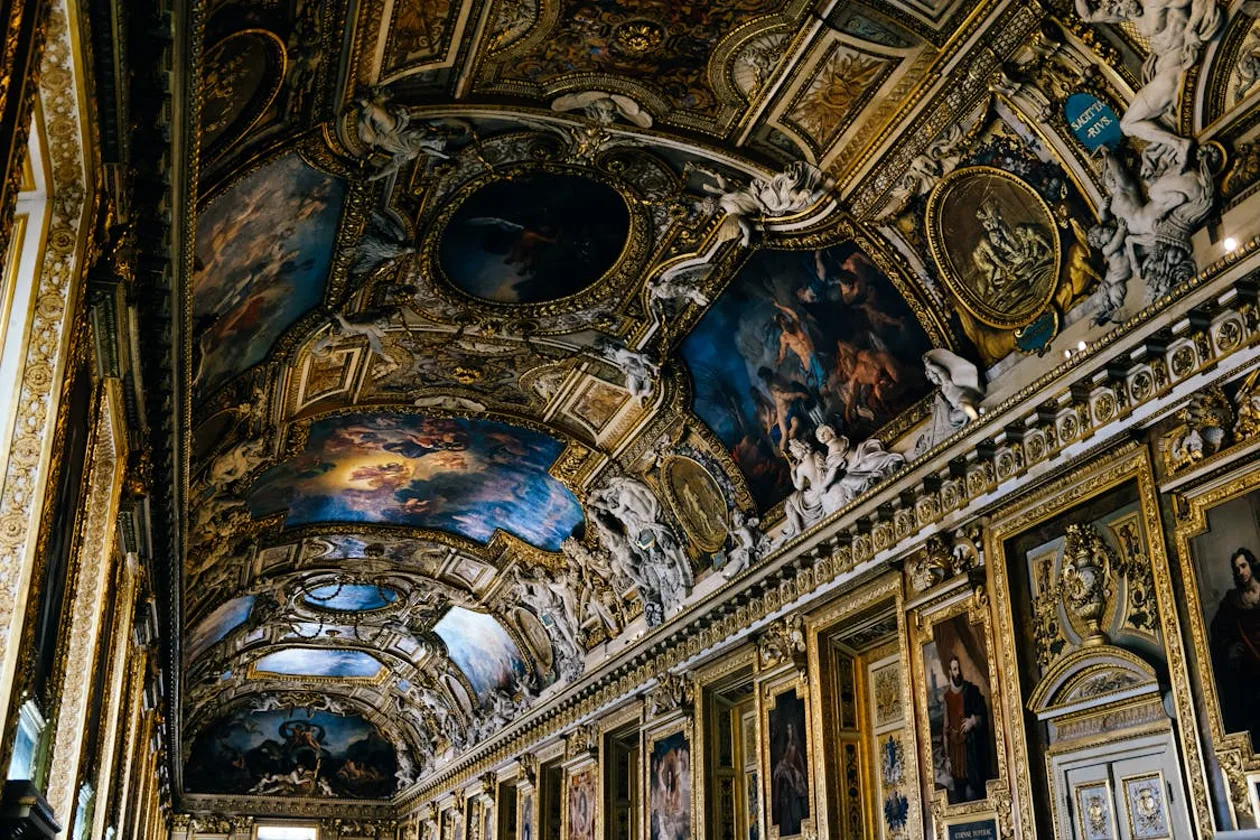
Why it matters: At 22.6 by 9.1 metres, this is the largest oil painting on canvas ever made. The original commission was given to Paolo Veronese and Francesco Bassano after the 1577 fire destroyed the previous fresco cycle. Both died before completing it. Tintoretto, then 70, submitted a finished model in competition and was awarded the contract. He completed it with his son Domenico over three years. The subject — the Christian Paradise with over 700 figures arranged in hierarchical rings — was chosen by the Council itself, to fill a wall proportioned to contain an entire theology.
What to notice: Stand at the far end of the hall (the Paradiso wall) and look back across the full 53-metre length. From here the painting resolves into a legible hierarchy — Christ and the Virgin at the apex, saints and martyrs in concentric arcs below, the blessed filling the outer rings. Then walk forward 20 metres and stop again. The reading changes. The figures in the foreground become individual — you can find Saint Mark with his lion, Saint Jerome with his book. Tintoretto built a painting that works at two scales simultaneously: theological order from a distance, human detail up close.
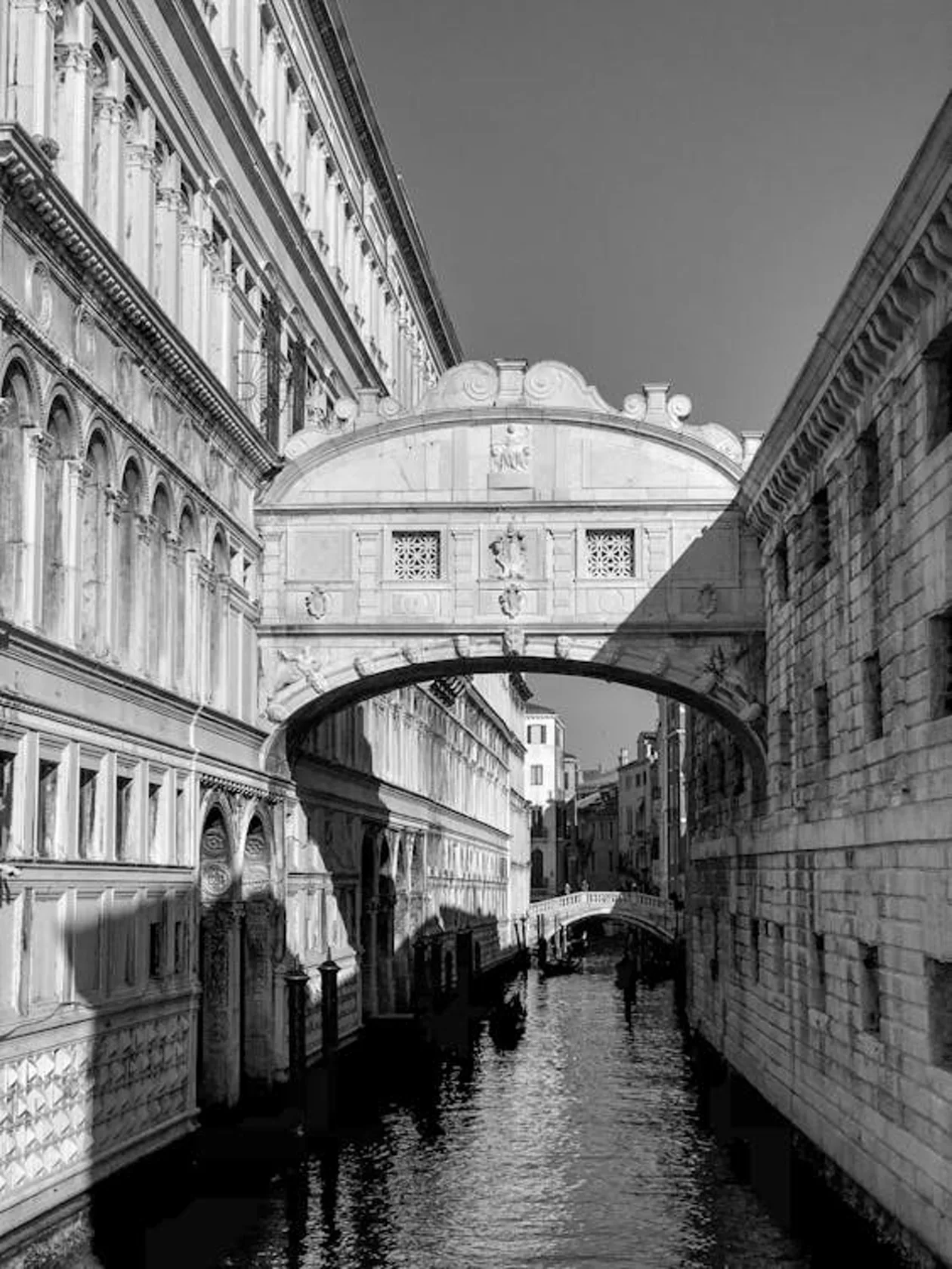
Why it matters: The bridge was commissioned not as a landmark but as a functional connector — a secure passage between the palace's interrogation rooms and the New Prisons across the canal. Antonio Contino, a nephew of Rialto Bridge architect Antonio da Ponte, built it in the Baroque style the palace's Gothic exterior was already departing from. The name came later, from Byron's Childe Harold's Pilgrimage (1812). The stone lattice windows — decorative from outside, functional from inside — are what make it architecturally significant: ventilated enclosures that allowed guards to see in without allowing prisoners to communicate out.
What to notice: Cross it twice if you can — once quickly to see the windows and feel the enclosure, then back. The second time, stop at each window and look through the stone lattice at the canal below. The view frames a narrow slice of Venice: a sliver of water, the embankment opposite, the occasional boat. It's a deliberately restricted view — the architecture of deprivation. Then consider that most prisoners crossing this bridge were ordinary criminals bound for the New Prisons, not political enemies or Casanova. Byron's romanticized image of condemned nobles sighing their last sigh is largely fiction. The real story — a functional transit route for petty thieves — is less poetic but more honest about how power actually operated in the Republic.
How well did you look?
3 quick questions about what you just saw
Visit complete!
Share your visit or save it for later
Your collection