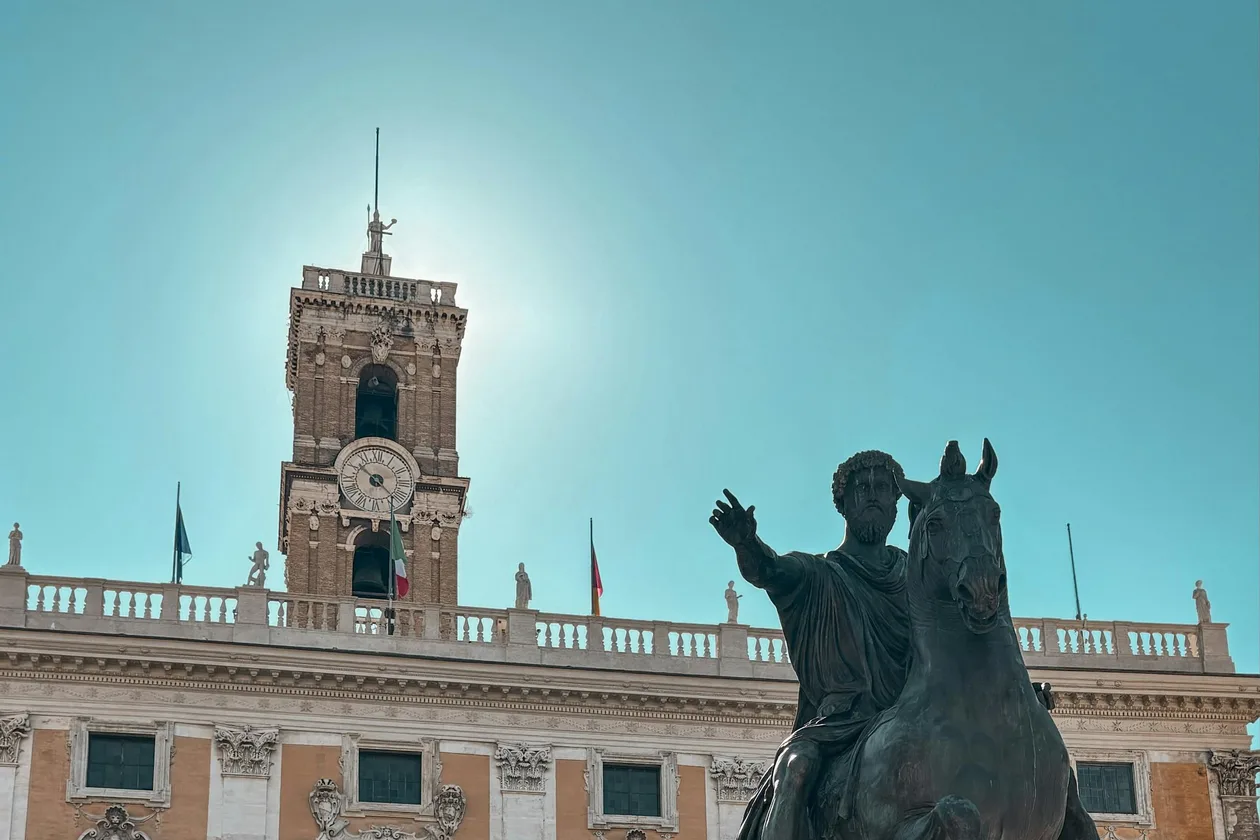
Capitoline Museums Tickets 2026
Tickets cost €15, or €9.50 reduced. The world's oldest public museum rarely sells out — the official site is the cheapest path.
Capitoline Museums tickets cost €15 in 2026, or €9.50 reduced. That is a fraction of the Vatican Museums for a collection that includes the Capitoline Wolf, the Dying Gaul, two Caravaggios, and the best Roman Forum view in the city. Tickets rarely sell out, and the museums sit just above Michelangelo's piazza — most tourists never find them.
How much are Capitoline Museums tickets in 2026?
Three ways to book: the official site (€15 + €1 presale fee), the Capitoline ticket office on Piazza del Campidoglio (no fee, same day only), or Tiqets (Skip-the-Line + Multimedia Video, €36, pickup at Touristation Office).
Current prices (2026):
- Standard: €15.00 adults / €9.50 reduced
- Online presale fee: €1 (no fee at the ticket office, cash or card)
- Capitolini Card (7 days): €15.50 / €11.50 — adds Centrale Montemartini
- Children under 6: free
- Non-residents aged 6-25: reduced rate
- Non-residents, Wednesdays: 50% off in the last two hours of opening
- Rome and Metropolitan City residents: free year-round (since February 2026, ID required)
Two things about that reduced rate that most sites get wrong. It goes by residence, not nationality: the official concession list says non-resident visitors aged between 6 and 25, so an American 22-year-old qualifies as readily as a French one. And the Wednesday half-price window applies to non-residents only, in the last two hours before closing, which in normal season means from 5:30 PM.
The €20.50 exhibition-inclusive ticket you may still see quoted was a temporary rate that ran from 13 May to 19 July 2026 and is no longer on sale. The Vasari e Roma and Angeli shows are still up, and the museums list them under the ordinary ticket. Separately, the Diego Rivera exhibition at Villa Caffarelli (9 June to 13 December 2026) has its own ticket at €15, €13 reduced, with family rates of €22 for two adults plus under-18s and €11 for one adult plus under-18s. It does not include the museums, and the Capitolini Card does not cover it either.
Whatever you buy in advance is non-refundable and cannot be changed. Confirm current rates on the official tickets page before booking.
Where to book
Our take: The official site is the cheapest direct booking and Capitoline rarely sells out — start there. Tiqets is only worth it if you want the multimedia video introduction and don't mind picking up your ticket at the Touristation Office on Piazza d'Ara Coeli 16 before entering.
What to look for at the Capitoline Museums
The Capitoline Wolf
Ground floor, Palazzo dei Conservatori. The bronze she-wolf is Etruscan, dating to the 5th century BC. The twins Romulus and Remus were added during the Renaissance. It's the symbol of Rome, and it's smaller than you expect. The power is in the wolf's expression: alert, tense, protective. Stand close enough to see the individual hairs on the fur.
The Dying Gaul
Hall of the Gladiator, Palazzo Nuovo. A Roman marble copy of a lost Greek bronze. The warrior sits on his shield, wounded, dying, refusing to collapse. The anatomy is precise, but what catches you is the face. He doesn't look heroic. He looks tired. Visitors consistently call this the most moving sculpture in Rome.
Two Caravaggios in one room
Second floor, Palazzo dei Conservatori (Pinacoteca). St. John the Baptist and The Fortune Teller hang in the same gallery. St. John shows Caravaggio's signature chiaroscuro at full force. The Fortune Teller is earlier, lighter, almost playful. Compare them side by side to see how his style evolved in under a decade.
Marcus Aurelius on horseback
Exedra of Marcus Aurelius, between the two buildings. The original equestrian bronze from AD 175, moved indoors in 1981. It survived because medieval Romans thought it was Constantine, a Christian emperor. Every equestrian statue you've ever seen in Europe follows this model.
The Tabularium and the Forum view
Underground gallery connecting both buildings. The Tabularium was Rome's state archive in the 1st century BC. Walk through the corridor and you'll reach a series of travertine arches that frame the Roman Forum below. The Temple of Saturn, the Arch of Septimius Severus, the Basilica Aemilia. This is the best Forum view from any museum in Rome, and most visitors walk past the entrance without realising it's there.
Tips most sites won't tell you
Come on a Wednesday afternoon. Non-residents pay half price in the last two hours of opening every Wednesday, which is roughly 5:30 PM onwards in normal season. That is also when the tour groups have gone and the Caffarelli terrace catches golden light over the city. Cheapest and quietest at once, and nobody puts it on the front page.
Grab a floor plan at the entrance. The layout is genuinely confusing. Two buildings plus an underground gallery with limited signage. Visitors who skip the map consistently report missing the Tabularium and parts of Palazzo Nuovo.
The video guide (€6) is worth it here. Unlike museums with extensive wall text, signage at the Capitoline is sparse, especially in English. The video guide adds context that changes how you see the collection. The audio guide (€4) is a cheaper alternative, and there is a separate €4 audio guide written for children aged 6 to 12.
Don't skip Palazzo Nuovo. It's tempting to leave after Palazzo dei Conservatori, but the Dying Gaul, Capitoline Venus, and the Hall of Philosophers are all in the other building. The underground Tabularium connects them, so there's no need to cross the piazza outside.
Don't count on the MIC card. At €5 for 12 months of free civic museums it looks like the best deal in Rome, and for visitors it is not available: the official rules restrict it to adults resident or temporarily domiciled in Rome and the Metropolitan City, and to students at universities in the Metropolitan City. If you are moving to Rome for a semester, buy it at miccard.roma.it. If you are here for a week, buy the €15 ticket.
When is the Capitoline free?
First Sunday of every month, for everyone, under Italy's Domenica al Museo program. No pre-booking. Expect 1-2 hours of waiting on the busiest of these days.
Since February 2026, residents of Rome and the Metropolitan City enter free year-round with a valid ID at the ticket office. Children under 6 are always free, as are MIC card holders, licensed EU tour guides, ICOM members, and visitors with disabilities plus one companion. Roma Pass holders get free entry on their first sites and a reduced rate after that.
Two practicalities. Free tickets are not issued online: you request them by calling 060608 or at the Capitoline ticket office on Piazza del Campidoglio. And free entry does not extend to the separate Villa Caffarelli exhibition space, which always needs its own ticket.
For non-residents on regular days, the €15 ticket covers two buildings plus the Tabularium underground, one of the best museum prices in Rome.
How do you get to the Capitoline Museums?
The entrance is on Piazza del Campidoglio, Michelangelo's piazza at the top of the Cordonata staircase. From Colosseo metro (Line B) it's a 12-minute walk past the Roman Forum. Bus lines 44, 63, 80, 83, 87, and 170 all stop at Piazza Venezia, a 4-minute uphill walk from the museum entrance.
The piazza itself is part of the experience, designed by Michelangelo in 1536, with the star pattern paving completed centuries later. Walk up the Cordonata slowly; the building you enter through is Palazzo dei Conservatori, on the right of the piazza as you face the central Palazzo Senatorio.
- Museum
- Musei Capitolini (Palazzo dei Conservatori + Palazzo Nuovo)
- Address
- Piazza del Campidoglio 1, 00186 Rome
- Ticket
- €15.00 adults / €9.50 reduced (non-residents aged 6-25)
- Online fee
- €1 presale (no fee at the ticket office) · advance tickets non-refundable and non-changeable
- Wednesday discount
- 50% off for non-residents in the last two hours of opening
- Capitolini Card
- €15.50 / €11.50 (7 days, includes Centrale Montemartini; +€5.50 exhibition integration)
- MIC card
- €5 (12 months) — only for Rome residents, temporary residents and university students
- Diego Rivera at Villa Caffarelli
- Separate ticket €15 / €13 (9 June – 13 December 2026), not included
- Free entry
- First Sunday of every month · Rome residents year-round · MIC card · Children under 6
- Hours
- Daily 9:30 AM – 7:30 PM (last entry 6:30 PM) · 24 and 31 December 9:30 AM – 2:00 PM · 1 January 11:00 AM – 8:00 PM
- Closed
- 1 May, 25 December
- Metro
- Colosseo (Line B) — 12-min walk
- Bus
- 44, 63, 80, 83, 87, 170 to Piazza Venezia
- Book at
- Official site (€15 + €1 fee) · Tiqets (Skip-the-line + multimedia €36)
- Website
- museicapitolini.org
Hours and prices can change — confirm on the official site before you go.
Last verified: August 2026
Frequently asked questions
How much do Capitoline Museums tickets cost in 2026?
The standard adult ticket is €15.00, or €9.50 reduced. Online presale through the official site adds a €1 fee; same-day purchase at the ticket office on Piazza del Campidoglio has no fee. The higher €20.50 exhibition-inclusive rate applied only between 13 May and 19 July 2026 and is no longer on sale. The Diego Rivera show at Villa Caffarelli (9 June to 13 December 2026) is a separate €15 ticket, €13 reduced, that does not include the museums. Children under 6 enter free year-round.
What are the Capitoline Museums opening hours in 2026?
The museums open daily from 9:30 AM to 7:30 PM, with last admission at 6:30 PM (one hour before closing). Special hours apply on 24 and 31 December (9:30 AM to 2:00 PM) and 1 January 2026 (11:00 AM to 8:00 PM). The museums are closed on 1 May and 25 December. As of August 2026, no other closures are flagged on the official notices page.
Can you visit the Capitoline Museums for free?
Yes, on several conditions. The first Sunday of every month is free for everyone under the Domenica al Museo initiative — no reservation, but expect 1-2 hour queues on busy days. Since February 2026, residents of Rome and the Metropolitan City enter free year-round with a valid ID at the ticket office. Children under 6 are always free, as are MIC card holders, licensed EU tour guides, ICOM members, and visitors with disabilities plus a companion. Free tickets have to be requested by calling 060608 or at the Capitoline ticket office, and free entry does not cover the separate Villa Caffarelli exhibition space. Non-residents aged 6 to 25 get a reduced rate, not free entry.
Can tourists buy the MIC card?
No. The official rules limit the €5 MIC card to adults resident or temporarily domiciled in Rome and the Metropolitan City, and to students enrolled at public or private universities in the Metropolitan City of Rome. A visitor on a week's holiday does not qualify, and this is the single most repeated error about Capitoline pricing online. If you do qualify, the card gives free entry to the whole Sistema Musei di Roma Capitale for 12 months from activation — Centrale Montemartini, Ara Pacis, Mercati di Traiano, Museo di Roma, Galleria d'Arte Moderna, Museo Napoleonico and more. It is sold at miccard.roma.it, through the MIC Card app, at some museums of the Roma Capitale system, and at tourist infopoints.
How long do you need at the Capitoline Museums?
Most visitors spend 2 to 3 hours covering both buildings, the Pinacoteca, and the Tabularium underground. The official site recommends 3 hours for a thorough visit. A highlights-only route (Capitoline Wolf, Dying Gaul, two Caravaggios, Tabularium Forum view, Marcus Aurelius equestrian bronze) takes about 1.5 hours. Plan 4 hours if you want to read every wall text and explore the Conservatori courtyards.
Where can I buy Capitoline Museums tickets?
Three options. The official site (museiincomuneroma.vivaticket.it) sells tickets at €15 plus a €1 online presale fee, and it is the cheapest direct route. The Capitoline ticket office on Piazza del Campidoglio sells same-day tickets with no fee, cash or card. Tiqets offers a Skip-the-Line + Multimedia Video option at €36, useful only if you want the video introduction and don't mind picking up the ticket at the Touristation Office on Piazza d'Ara Coeli 16 before entering. Advance tickets bought online, through the 060608 call centre or at the counter are non-refundable and cannot be changed.
Are the Capitoline Museums worth visiting?
Yes, and they are one of the most under-visited major museums in Rome. The world's oldest public museum holds the Capitoline Wolf, the original Marcus Aurelius equestrian bronze, the Dying Gaul, two Caravaggios, and the Tabularium with the best Roman Forum view in the city. The collection is smaller than the Vatican's, which is the point: you can do a serious visit in 2 hours without the marathon fatigue. TripAdvisor reviews and Rick Steves both flag Capitoline as one of the few Rome museums you can usually walk into without a queue.
What is the best time to visit the Capitoline Museums?
Right at opening (9:30 AM) on a Tuesday, Wednesday or Thursday is the quietest window. School groups arrive between 10:30 AM and noon, so the first hour belongs to independent visitors. The 11:00 AM to 2:00 PM block is the busiest. Non-residents also pay 50% less in the last two hours of opening every Wednesday, so a 5:30 PM Wednesday arrival is the cheapest quiet slot of the week, and the Caffarelli terrace catches golden light over the Roman Forum at exactly that hour in spring and autumn. Avoid the first Sunday, which has free entry and the longest queues of the month.
What's included in the Capitoline Museums ticket?
Entry to both buildings — Palazzo dei Conservatori and Palazzo Nuovo — plus the underground Tabularium that connects them, and the exhibitions running inside the main museum spaces. It does not cover the separate exhibition space at Villa Caffarelli, where the Diego Rivera show is sold as a standalone ticket. The audio guide (€4) and video guide (€6) are sold separately at the ticket office, along with a children's audio guide (€4, ages 6-12). The Capitolini Card (€15.50, 7 days) adds the Centrale Montemartini, the sister museum across the river that houses ancient sculpture inside a 1912 power plant; exhibition access on that card costs €5.50 extra.
Is skip-the-line necessary at the Capitoline Museums?
No, in most cases. Unlike the Vatican Museums or Colosseum, the Capitoline rarely has long queues — Rick Steves and TripAdvisor reviews from 2025 and 2026 consistently report 0-15 minute waits at the ticket office. Individual visitors cannot reserve a time slot at all except by buying the online presale ticket. Pre-purchase saves time only on the first Sunday of every month and during major exhibition openings. The Tiqets Skip-the-Line + Multimedia Video ticket (€36) costs more than double the official entry and requires picking up your ticket at the Touristation Office before going in — worth it for the multimedia introduction, not for queue-jumping at a museum that rarely has a queue.
Still planning Rome? See our best art museums in Rome ranking, the Rome museum tickets 2026 summary, free museums in Rome 2026, or Rome museum opening hours. Pairing the Capitoline with other sites? It sits a 12-minute walk from the Colosseum and 10 minutes from the Pantheon, both of which work well as half-day combinations. Heading to the Vatican too? Check our Vatican Museums tickets guide and Borghese Gallery tickets guide. For two more Caravaggios with no queue, Palazzo Barberini is a 15-minute walk away. Ready to book? Start at the official site — €15 plus €1 fee, same inventory as the ticket office, no markup.
- Best Art Museums in Rome for First-Time Visitors
- Free Museums in Rome 2026
- Rome Museum Opening Hours 2026
- Vatican Museums Tickets 2026: Prices & How to Book
- Colosseum Tickets 2026: Prices & How to Book
- Borghese Gallery Tickets 2026: Prices & How to Book
- Rome Museum Tickets 2026 (All Prices)