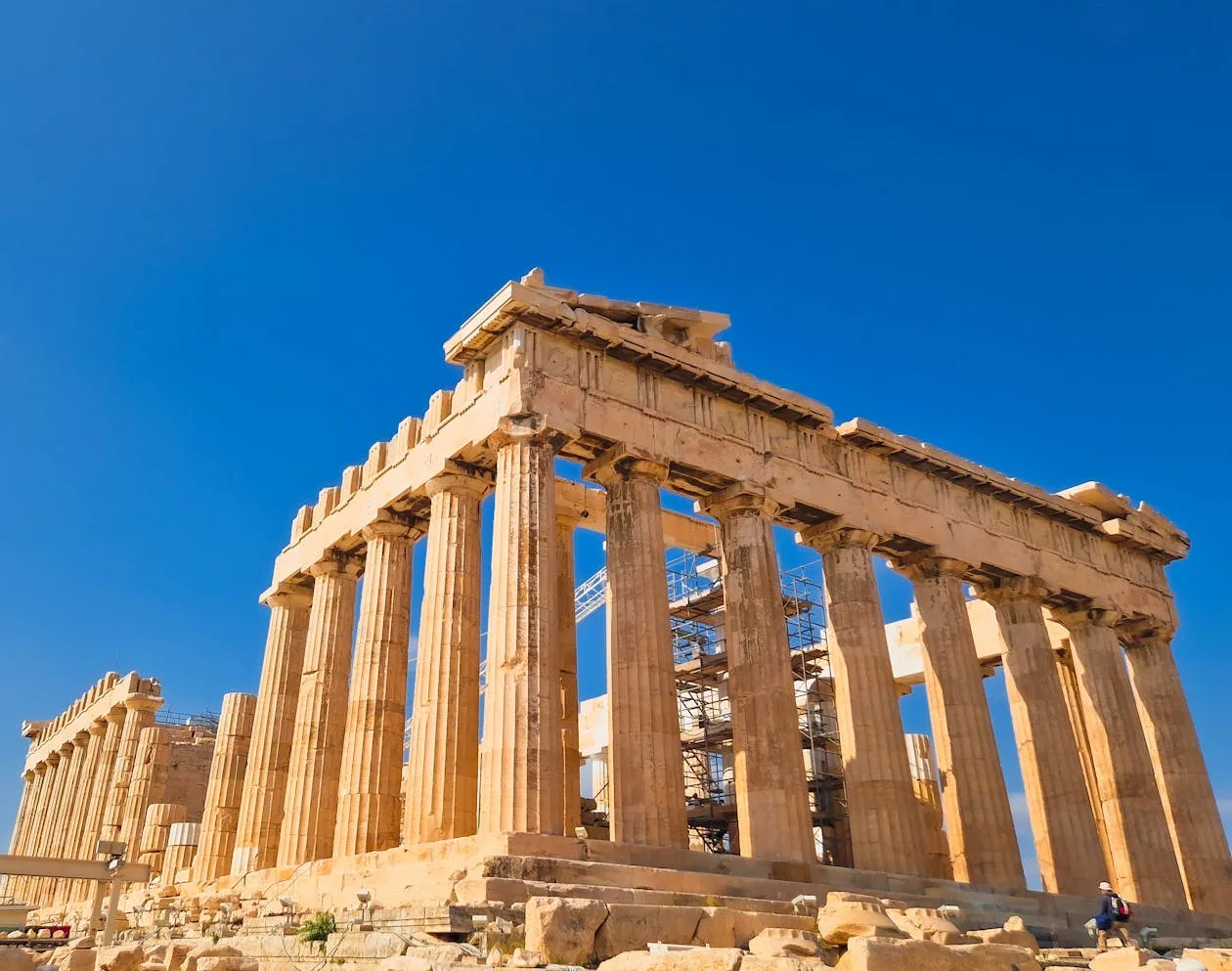
Follow the route the Athenians walked
Structure by structure through the Parthenon, Erechtheion, Propylaea and Temple of Athena Nike — with timing and what to actually look at
Get your free guide
Enter your email to unlock the full room-by-room guide. One email unlocks all Athens museum guides.
Free · No spam · Unsubscribe anytime
The Parthenon is under scaffolding. The interiors are off-limits. You can't touch anything. Come anyway — the hill itself is the exhibit, and most people leave having only half-seen it.
The Propylaea is the monumental gateway (437–432 BC) and one of the most underrated buildings on the hill. Before you walk through, look at the columns flanking the central passage: the outer ones are Doric, the inner ones are Ionic — two architectural orders in the same structure. The ceiling above the central passageway once had coffers painted with golden stars on a blue field. Stop at the top of the ramp and look back at Athens spreading below.
Most visitors stand in front and leave. Walk the full perimeter. From the north side, look along the row of columns and notice the slight outward bow at the mid-point — this is entasis, a deliberate optical correction so columns don't appear to sag. On the east side, where the cult statue of Athena once stood facing the rising sun, you can see the Aegean on a clear morning. Check the restoration work: new Pentelic marble from the original quarry is intentionally lighter — the timeline of the building is readable from the outside.
Cross to the Erechtheion (421–405 BC) on the north side of the hill. The six figures carrying the porch roof instead of columns are replicas — five originals are in the Acropolis Museum below, and the sixth is in the British Museum in London. The museum places a cast in the sixth slot so the absence is visible. From the south edge here, look toward the theater of Dionysus carved into the hillside below. Before leaving, find the Temple of Athena Nike on your way back to the Propylaea — it's to the right of the gateway and easy to miss.
The south entrance (at Thrasyllou and Dionysiou Areoparitou, near the Theater of Dionysus) is consistently less crowded than the main west entrance at any hour. Tour group buses unload at the west side. The south entrance is also a 5-minute walk from the Acropolis Museum.
Morning slots in June–August sell out days or weeks ahead. Book on tickets.hh.gr before your trip and select your entry window. Without a ticket, expect a 45–60 minute queue at peak times. You can enter from 15 minutes before to 15 minutes after your slot.
Cruise ships dock in Piraeus and deliver thousands of passengers to the hill between 10am and 2pm. Early morning and late afternoon are measurably quieter and, in summer, meaningfully cooler. The 8am slot often has the hill to fewer than a hundred visitors.
The Acropolis Museum (a 5-minute walk from the south entrance) explains what you just saw. Seeing the original Caryatids in the museum after having stood in front of the replicas on the Erechtheion changes how both feel. If heat is a factor in summer, flip the order — the museum is air-conditioned.
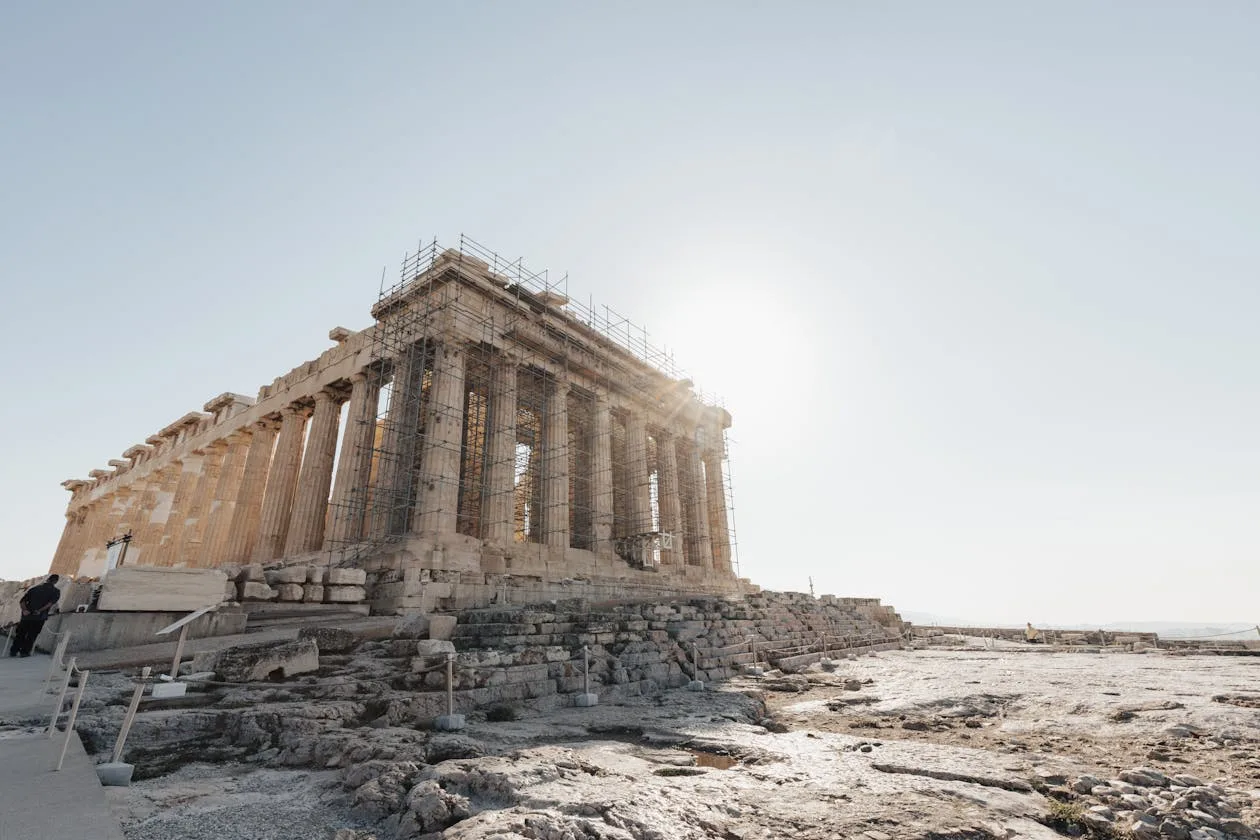
Why it matters: The largest Doric temple ever built, and still the most geometrically precise ancient structure standing. The 4:9 ratio — column diameter to column spacing, height to width — is repeated throughout the entire building. Nothing about it is accidental.
What to notice: Stand at the northwest corner and look along the stylobate (the platform). It curves upward at the center by about 6cm. The whole building bends slightly to prevent the optical illusion of sagging under its own weight.
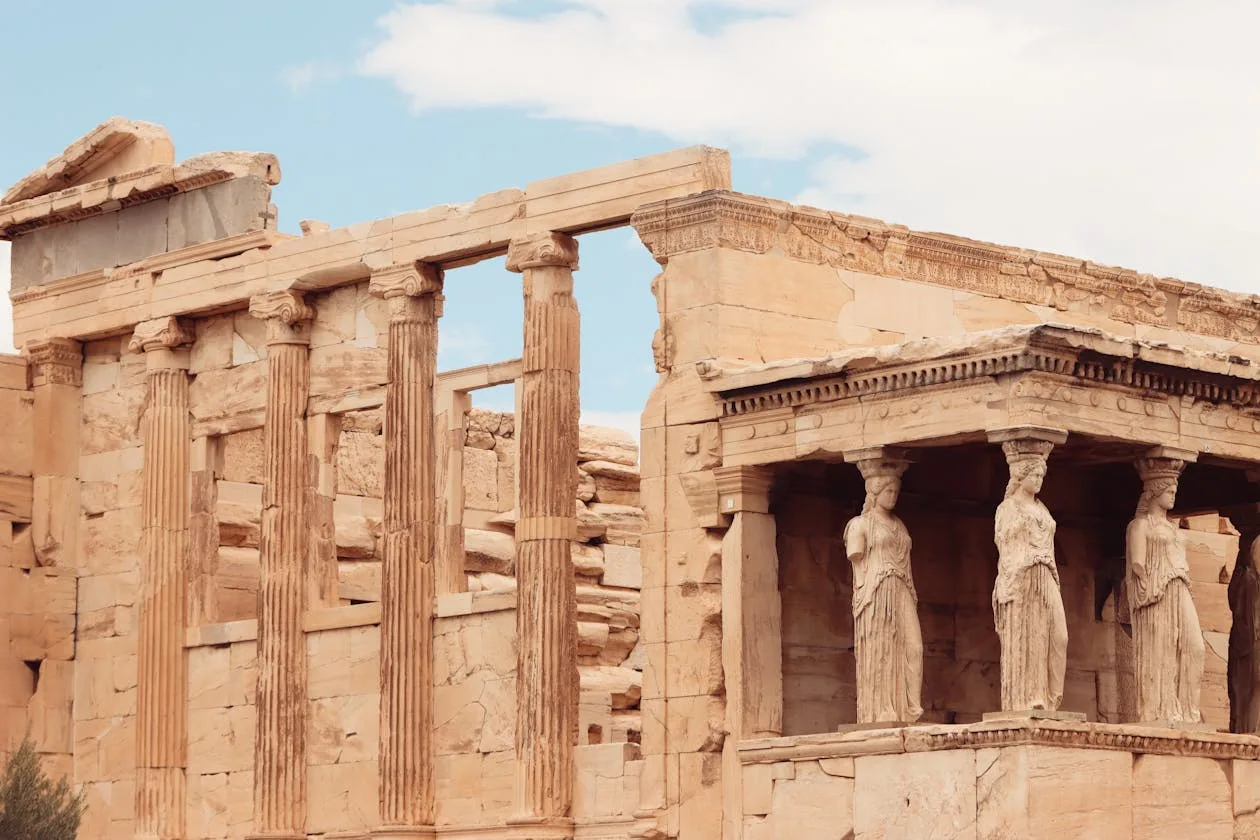
Why it matters: Six draped female figures replace the columns that would normally carry the porch roof. The arrangement is structurally sound — the figures' necks are thickened to carry the load, and the drapery falls in vertical folds that echo fluted column shafts.
What to notice: These are replicas. Five originals are displayed at eye level in the Acropolis Museum below the hill. The sixth was removed by Lord Elgin in 1801 and remains in the British Museum in London. The museum places a cast in the sixth position — the absence is intentional.
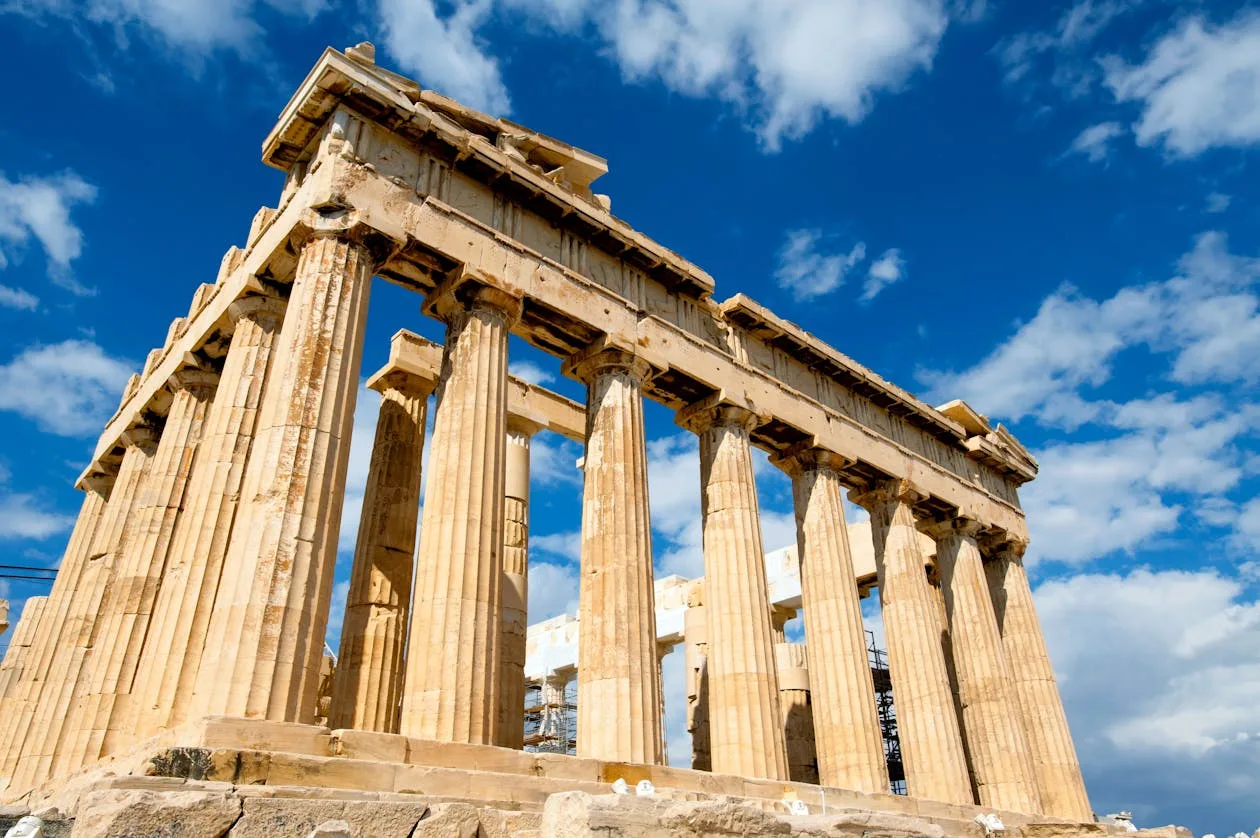
Why it matters: The monumental gateway to the Acropolis is itself one of the great buildings of classical antiquity — but most visitors walk through it without stopping. It mixes Doric (outer colonnade) and Ionic (inner passage columns) in a single structure, which was unusual.
What to notice: Look up at the ceiling of the central passageway. The marble ceiling beams are original. The coffers between the beams once had gilded stars painted on a deep blue field — one of the few places on the Acropolis where the original color scheme is documented.
How well did you look?
3 quick questions about what you just saw
Visit complete!
Share your visit or save it for later
Your collection