5.17 Metres of Marble. One 26-Year-Old. 500 Years of Getting It Wrong.
A room-by-room route through the Accademia — David, the four Prisoners, and what everyone misses on the way in and out.
Get your free guide
Enter your email to unlock the full room-by-room guide. One email unlocks all Florence museum guides.
Free · No spam · Unsubscribe anytime
Most visitors walk straight past the Prisoners to reach David and spend 10 minutes photographing a statue they've already seen on every postcard. Slow down. The Prisoners are four unfinished Michelangelos in the hallway. They are, arguably, more interesting than the finished one at the end.
Enter and turn right into the long hall leading to the Tribune. Don't rush. Four colossal unfinished sculptures line the walls — the Prisoners (also called the Slaves), carved between 1519 and 1534 for Pope Julius II's tomb. Michelangelo abandoned them. You can see exactly where the chisel stopped. Rough stone transitions into polished skin, mid-gesture. These are not failed sculptures. Many art historians argue they are Michelangelo's most honest work — figures literally emerging from the marble, not yet fully separated from the stone. The theory that Michelangelo left them unfinished intentionally (the 'non-finito' philosophy) is disputed, but the effect is undeniable.
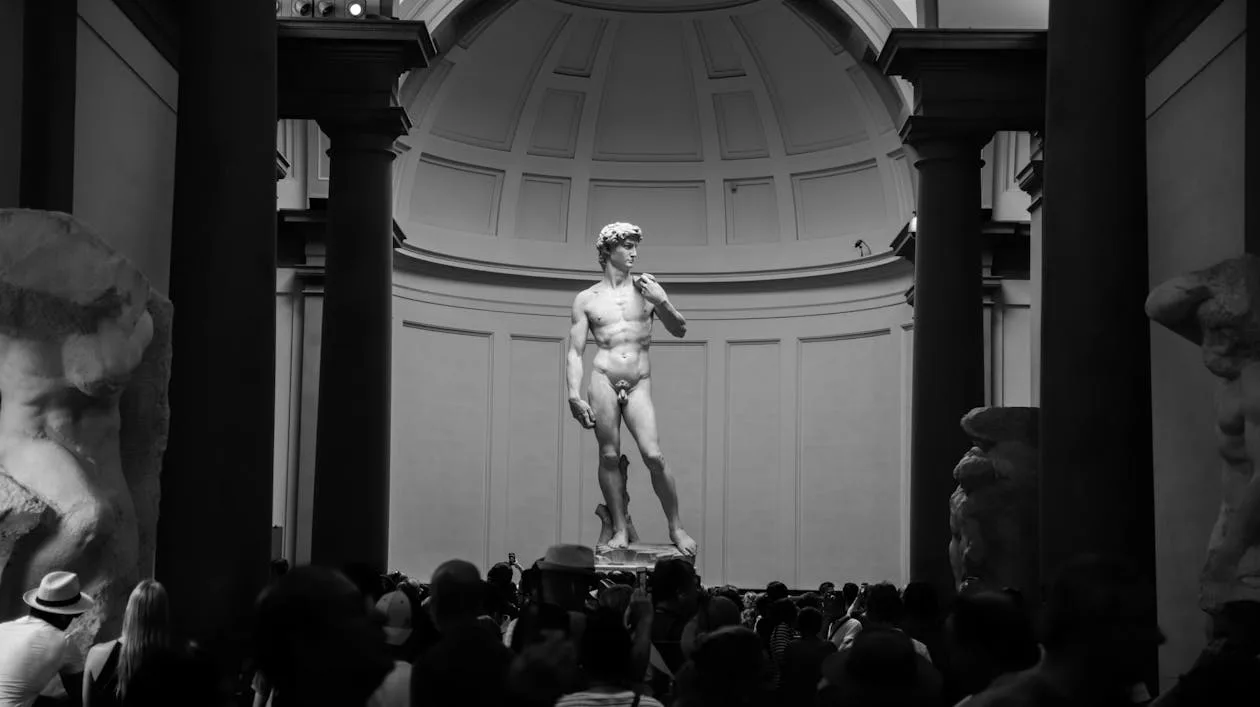
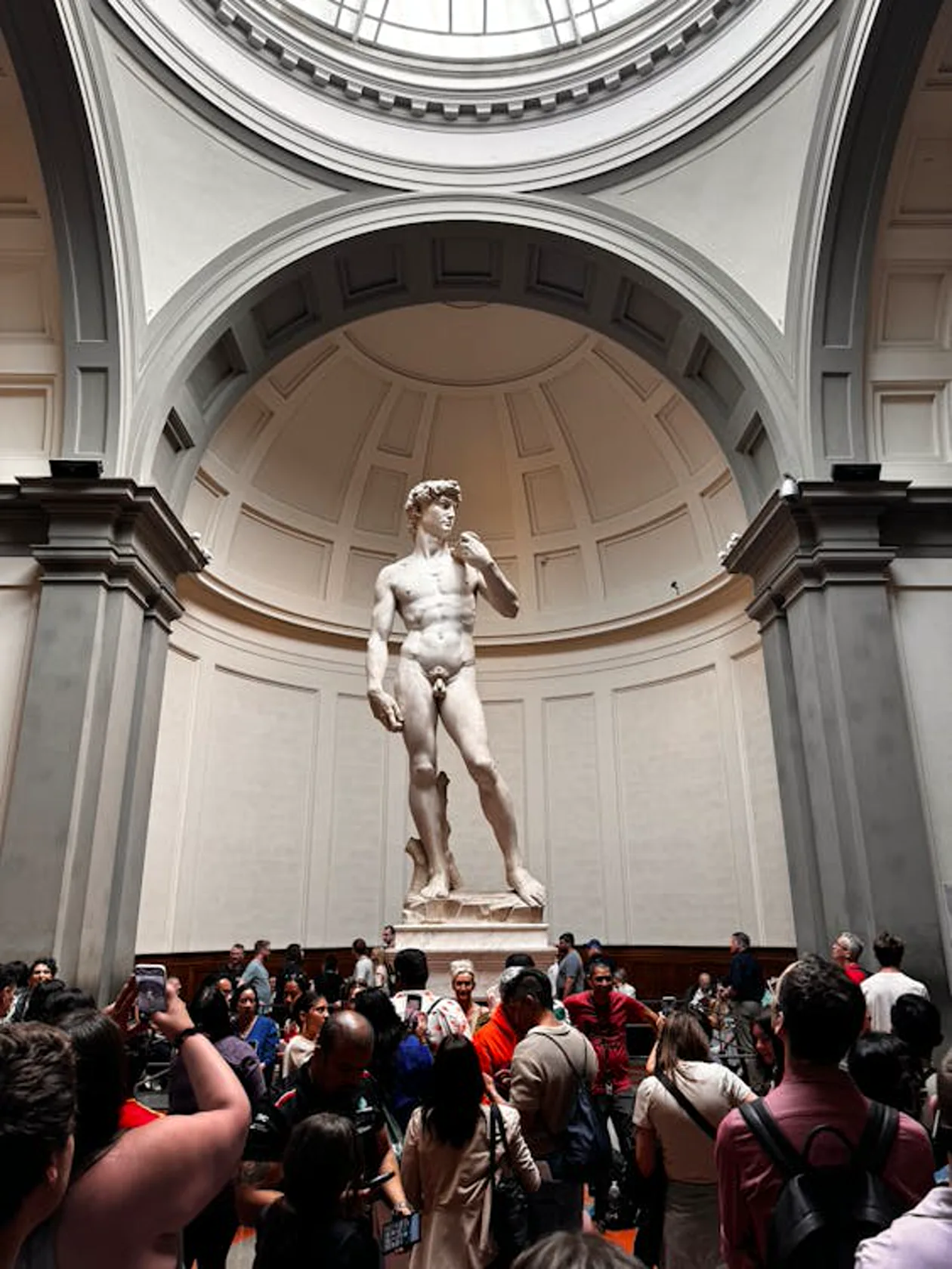
David stands 5.17 metres tall on a 1.7-metre base, under a purpose-built dome. Walk the full 360° before stopping. Then stop to the right of the statue — David's left — and look up at the right hand. It is anatomically oversized: the fingers are too long, the tendons too prominent. Michelangelo did this deliberately. David holds a sling in that hand. The weight of the stone, the tension of the moment before he throws — it's all in the hand. Then look at the face. David isn't celebrating. He's calculating. The battle hasn't started yet. What Michelangelo carved is anticipation, not triumph.
Behind the Tribune, two wings hold the Accademia's often-overlooked collection: a museum of medieval and Renaissance Florentine painting (13th–16th century), and one of the world's finest collections of historical musical instruments. The instrument collection includes Stradivari violins and a Bartolomeo Cristofori piano — the earliest surviving piano in existence, built around 1700. Most visitors turn around at David and leave. The instrument room is almost always empty. The Cristofori piano is worth five minutes: this is the instrument that changed all music.
The Accademia official site (galleriaaccademiafirenze.it) sells timed tickets for €20 including the booking fee. Third-party 'skip-the-line' tickets cost €35–39 and use the same entrance. Unless you're booking the week before in peak season, the official site is the right option. The 8:15 AM slot is always easier to get than midday slots.
Every visitor instinctively stands in front. From a 45-degree angle to David's right side, the proportions of the hand become visible, the veins in the forearm read clearly, and the gaze has direction. The crowds also thin out at this angle. Spend five minutes here before rejoining the main viewing position.
Most visitors walk past the Prisoners at speed heading for David, then rush back past them on the way out. Stop in the hallway on the way in, when you have attention and energy. By the time you've spent 25 minutes with David, the Prisoners become an afterthought. They deserve the first 15 minutes.
The 1910 replica in the Piazza is made from the same Carrara marble and is technically precise. What it lacks is five centuries of handling, the particular quality of light inside the Tribune, and scale. In an open piazza, David is just large. Inside the Accademia, under the dome, it is enormous. The room changes the sculpture.
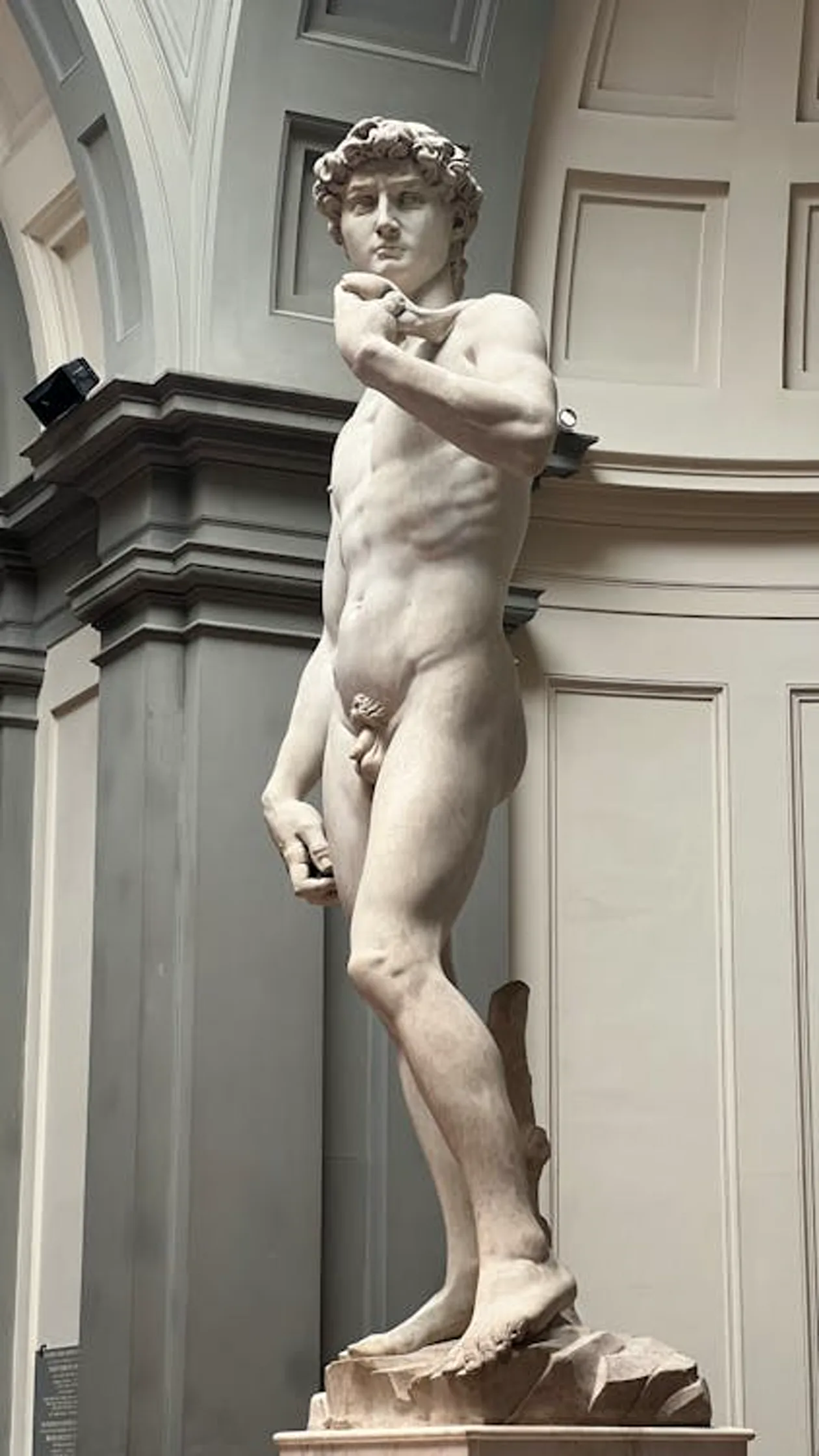
Why it matters: Michelangelo was 26 when he started and 29 when he finished. The marble block had already been worked and abandoned by two other sculptors — it was considered too narrow and too damaged to use. Michelangelo took it anyway. David was commissioned for Florence Cathedral, to stand 40 metres above street level. When it was finished, the city decided it was too good for the roofline and placed it in the Piazza della Signoria instead. It stood outside for 369 years before being moved indoors in 1873.
What to notice: Look at the right hand: anatomically, it is too large for the body. Michelangelo scaled it deliberately — a sculptor working for a rooftop viewing angle exaggerates the parts that read from below. Even after the decision to place David at street level, Michelangelo kept the hand. Then look at the eyes: each pupil is carved in the shape of a heart. This detail is invisible from ground level and was almost certainly not meant to be seen.
Why it matters: Michelangelo carved the four Prisoners for the tomb of Pope Julius II — a commission that haunted him for 40 years and was repeatedly redesigned, reduced, and delayed. When the project was finally abandoned in a simplified form, these four figures were left incomplete. They passed through several owners before the Medici donated them to Florence in 1564.
What to notice: Walk slowly along the row and look at the surface transitions: in one figure, a hand emerges from uncut stone. In another, a torso is polished while the head is still blocked out. The 'awakening slave' — the most famous of the four — has a face half-buried in the marble, as if surfacing from underground. Whether Michelangelo intended the non-finito effect or simply ran out of time is a question art historians still argue. Standing in front of them, the answer feels less important than the question.
How well did you look?
3 quick questions about what you just saw
Visit complete!
Share your visit or save it for later
Your collection